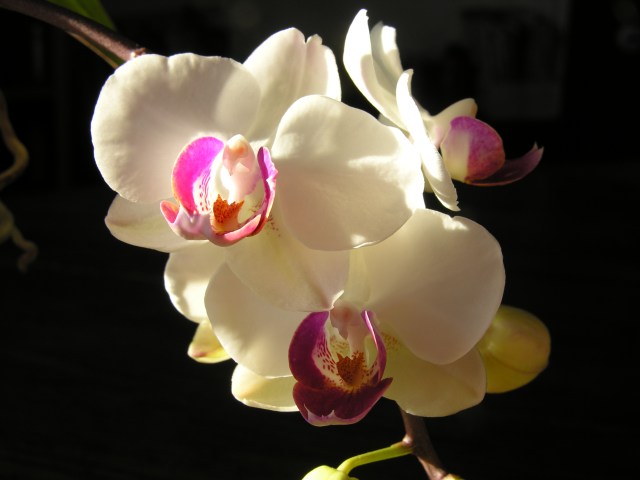
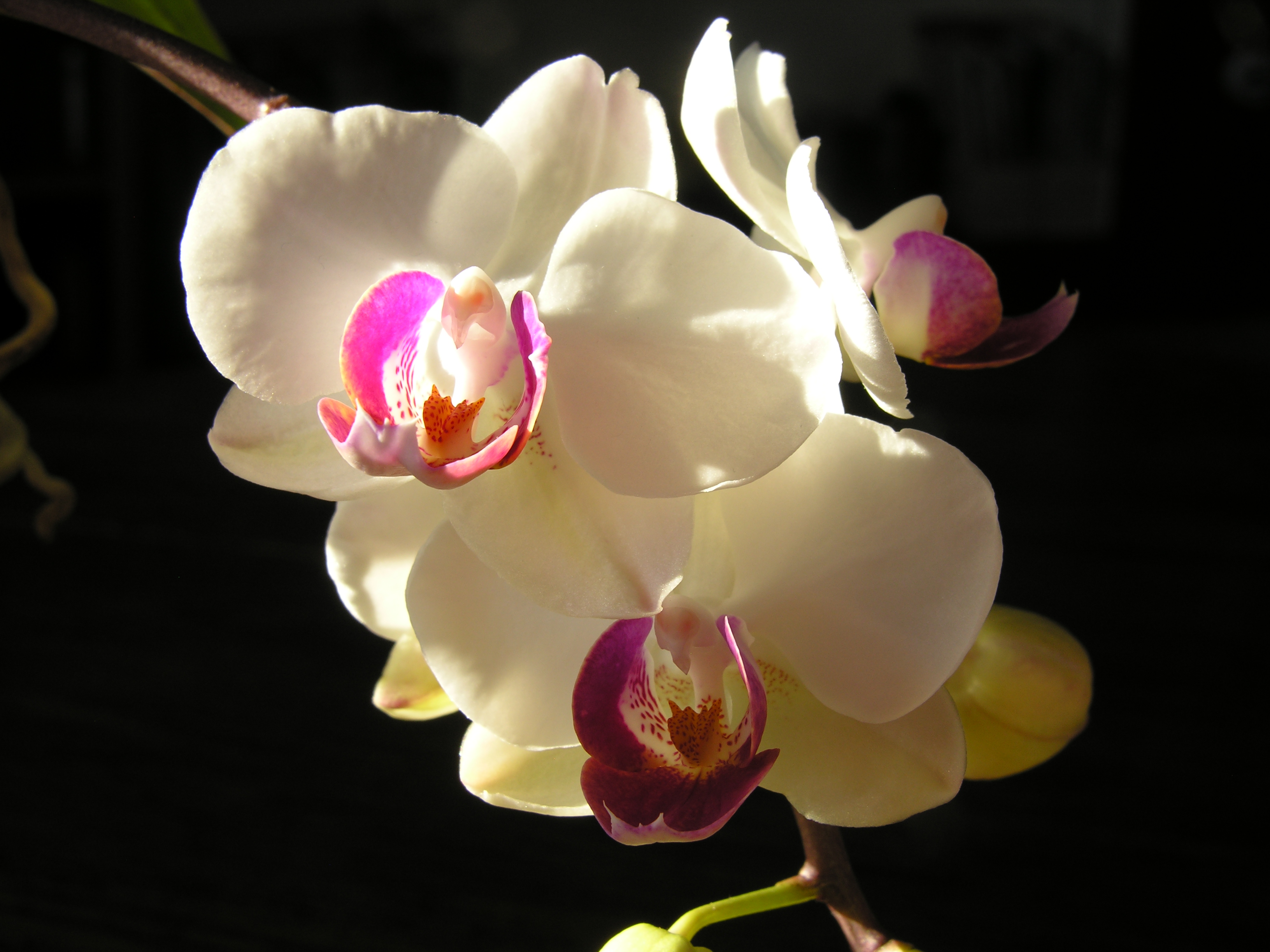
Phal. "Little Sunny"
This post is by special request. One of our most loyal readers has asked me to write about getting (or persuading) phalaenopsis, or moth orchids to re-bloom, and I am happy to oblige. Better late than never…..
My first “phal” was purchased at a local market, as so many of them are. I took it home and immediately began researching the species. But it was only after talking with experts at orchid shows and joining an orchid club where the members knew much more than I did that I actually began to “get” orchids.
I’ll cut right to the chase. Here’s the most important thing (in my humble opinion): find out where the orchid you bought grows in the wild. That way, you can have a better idea of how to grow it at home. The idea of buying something beautiful, something alive, and tossing it after it flowers is abhorrent to me. It is such a waste. Anyway, having a resting orchid gives you an excuse to buy more orchids, because that way you will have different plants blooming at different times. Yay!

Phal. "Yellow Butterfly"
Phalaenopsis Revealed
Back to phals. These orchids are epiphytes. They don’t live in the ground (although some other orchid species do). They attach to trees and hang there, absorbing moisture and nutrients from the air. That means the one surefire way to kill a phal is allowing its roots to stay wet so they rot. They must have good air movement (as there would be high on a tree branch) and cooler temperatures – 60s and 70s are fine.
If you look at your plant, you will notice that there are two different kinds of roots: ones that go down into the potting medium and those other gnarly ones that sit on top. Those surface roots are covered in velamen, and when you water the plant with the sprayer in the sink (as you should) that velamen will turn green as it absorbs the water – something I enjoy watching.

A blue ribbon phal at an orchid show
Potting
Orchid people can debate the merits of various potting media for hours. I just use what makes my plants happy. For phals, I buy a coarse potting medium that contains mostly bark. Again, remember that the roots like to have air circulation, and air travels through the medium. I buy my various potting media from Kelley’s Korner, (link below) but you can get yours wherever you wish. I do not like sphagnum moss for orchids and if I buy one that is planted in it, I repot the plant as soon as possible. I don’t find that sphagnum allows enough air circulation, and it’s hard to get the water to penetrate it properly.
Here’s another very important tip: it’s important to allow new potting medium to soak in water for about a week BEFORE you use it, so it is properly saturated before you stick a plant in there. If you plant an orchid in new, dry medium, every time you water it, the medium will suck away all the moisture and your orchid will die of thirst. As for when to pot, my experience is that phals really don’t care if you re-pot them while they’re in bloom, although my gardener’s instincts tell me I should wait until the flowering is over. I don’t always, though, and the plants are fine.
To re-pot, remove the orchid from the old pot and examine the roots carefully. Cut off any that are black or shriveled. Phals need re-potting when their potting medium starts decomposing and turning into soil. Every couple of years should be good enough.
Put a bit of your saturated medium in the bottom of the pot. Use the same pot or one only very slightly larger. Hold the plant in the center of the pot, kind of suspended in the air, and dribble the medium around it until it surrounds the plant. Do not shove it down into the pot, or try to pack the roots in. The plant will be wobbly for a while, so be careful when you move it. Water it well with Superthrive to help stimulate root growth.
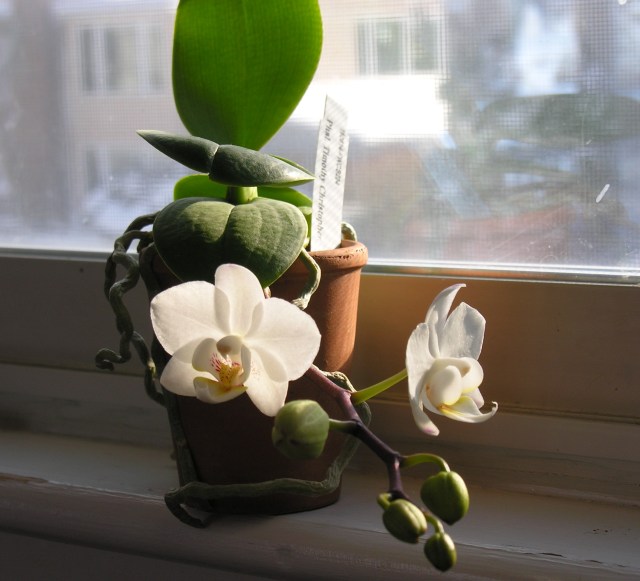
Mini phal "Timothy Christopher"
Water and Food
I water my phals thoroughly every week at the kitchen sink, spraying the medium for at least a minute, and then letting the excess water run out. Don’t let water accumulate in the plant’s crown, because it could cause rot. If some gets in, just stick the tip of a paper towel down there to get rid of most of it.
I also feed my phals, and all my other orchids. Here’s my routine: one week, plain water. The next week, Superthrive. The third week, plain water, and the fourth week, fertilizer. These days, I am using Michigan State University’s “Tap Water Special” which is available at orchid shows and at Kelley’s Korner, or you can find it elsewhere online.
Light
It’s important to provide your phalaenopsis with enough light. Mine sit in various windows throughout the house and do well in different exposures, although the southwest side can get a bit too toasty in the summer. Anything except shade is ok. Use common sense and move your orchid around until it seems happy. Pay attention. If the leaves wrinkle, it’s not getting enough water. If the leaves get yellow scorching on them, move it to a less sunny spot.

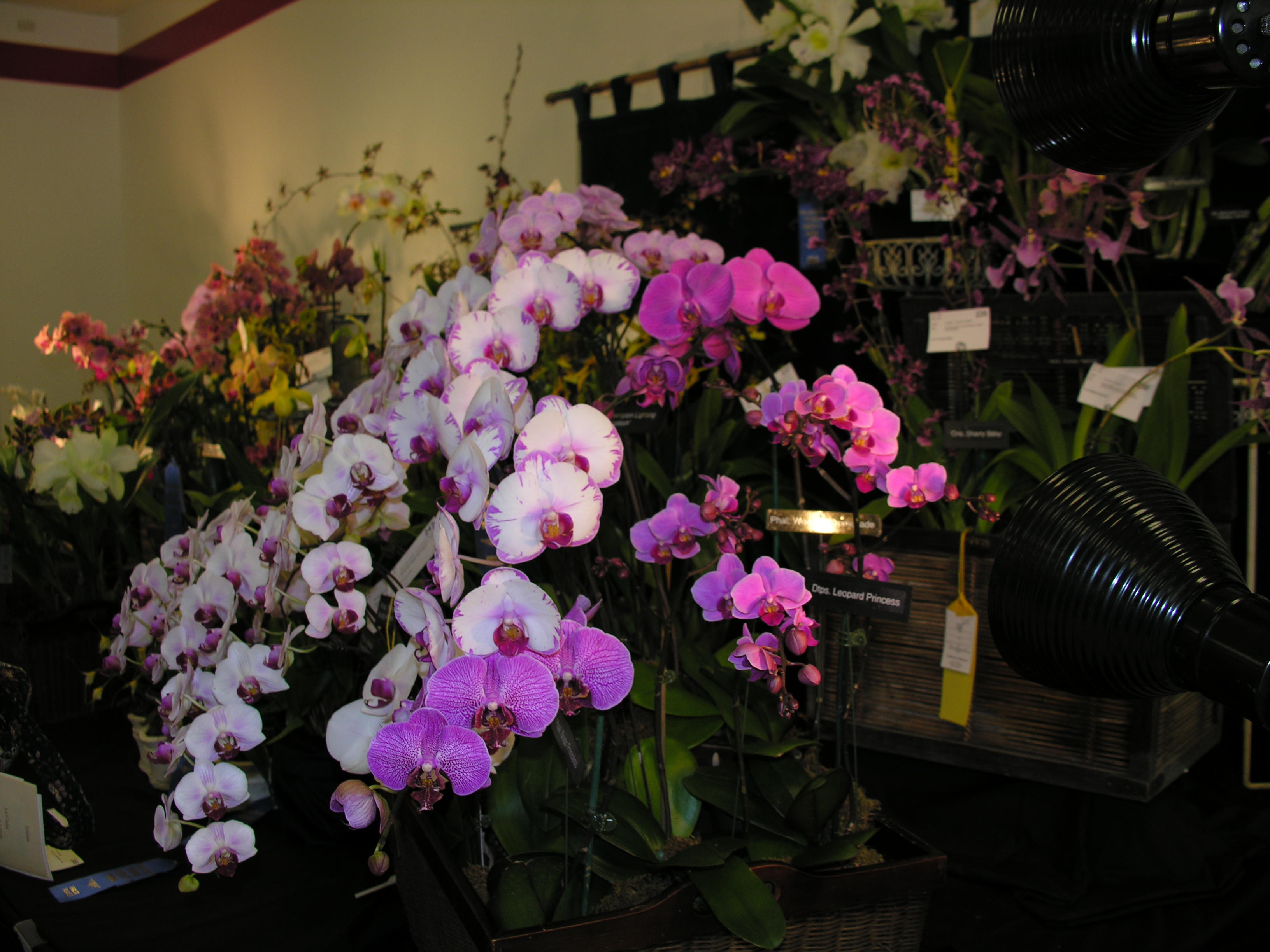
Large phals at an orchid show
Where to buy
I prefer buying my plants directly from the growers. That way I’m not paying a middleman – or woman – and I get healthy “well grown” plants, as they say in the orchid world. They’re often cheaper than the ones in the big box stores, too. But feel free to succumb to temptation wherever you find it. Just make sure you are buying a healthy phal. Use your gardener’s eye and check for insects, dead foliage, wilting buds and flowers etc. These are all signs of severely stressed plants that might not recover when you bring them home. Please do not fall for those pathetic “Just Add Ice” orchids. A couple of ice cubes a week is not even remotely enough water for a phal, and they hate cold water besides. This is a dumb idea aimed at lazy people, which we gardeners are not.
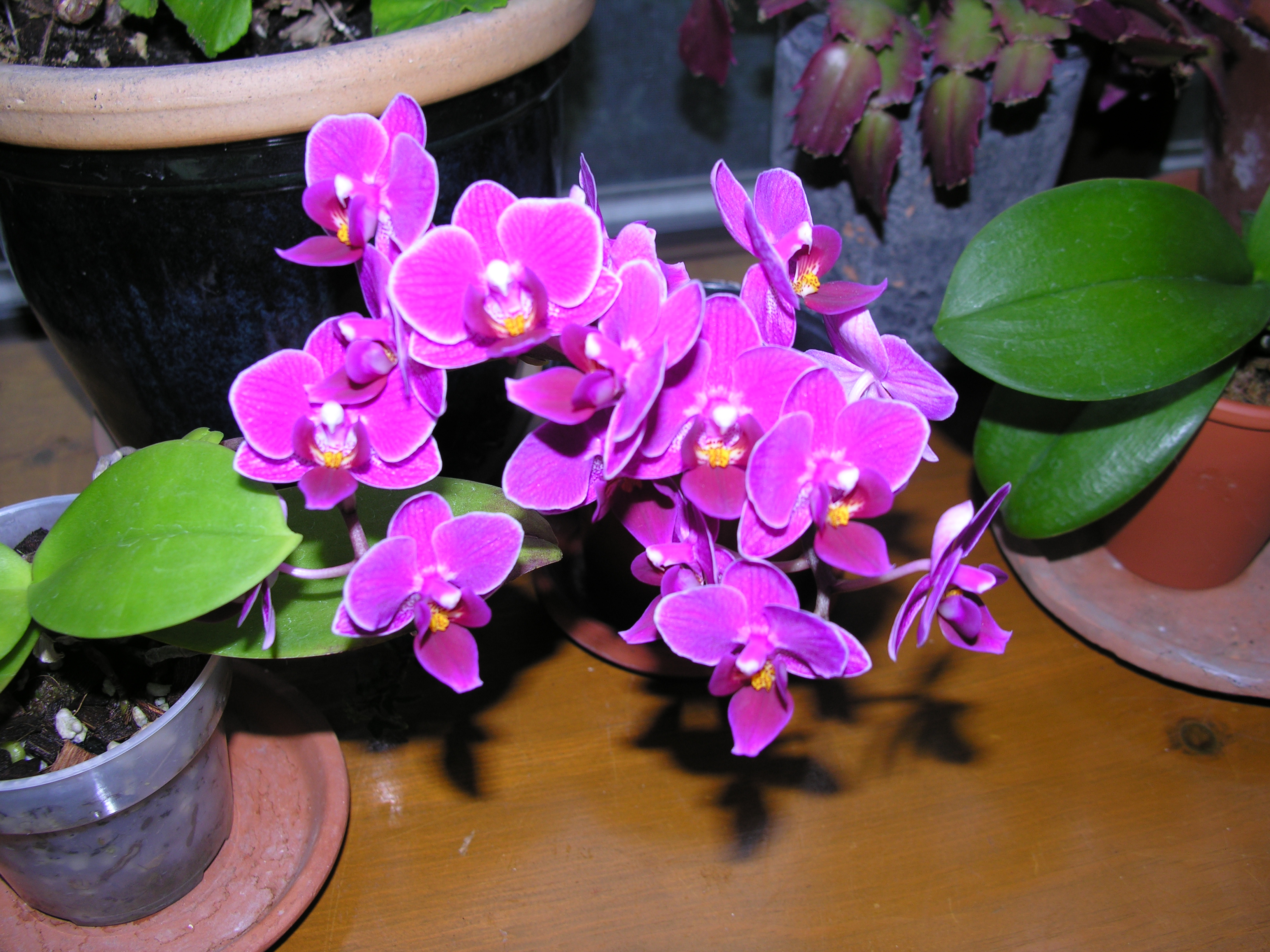
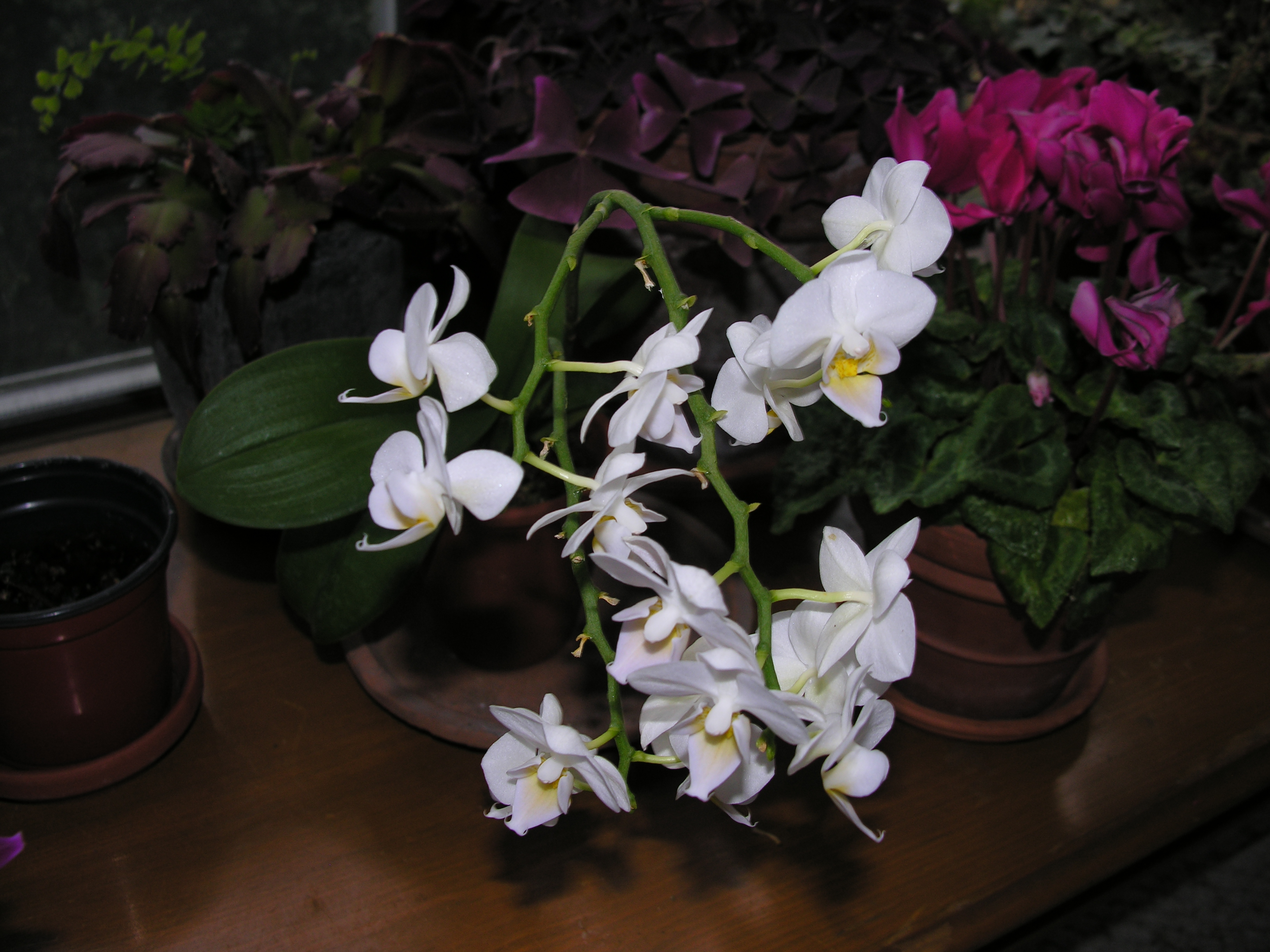
Also remember that the phalaenopsis species is way more interesting than the typical white phal that the designers on television seem to be obsessed with. There are minis and spotted ones and a whole range of interesting colors.
Feel free to write me with your phal questions. If you pay attention to your plant and really try to be sensitive to its needs, it will reward you with re-blooming – the ultimate prize for orchid lovers everywhere.















 Digging RI