
A Child’s Garden, Part II: What to Grow

Herbdoc again, with more tips on gardens for kids:

If you’re looking for some unusual seeds or plants that will spark your children’s curiosity and enthusiasm, here’s a short list of some that I’ve had great success with:

Eggplant: Pumpkin-on-a-Stick (Solanum aethiopicum)- I’m told this is used as a culinary vegetable in Asia, but we grow it      as   an ornamental.  When the fruit turns orange, remove all the leaves and you’ll have many little “pumpkins-on-a-stick!”

Twinkle Hybrid – harvest 2” eggplants; plant grows about 24” and is spineless.

Tomatoes:  Cherry: Riesentraube – In German the name means “Giant Bunch of Grapes”; it’s very appropriate.

Black Pearl – Tastes like a tomato right off the vine, but if chilled, has a Concord grape flavor.

Peacevine – Tresses of small red tomatoes; high Vitamin C content

Pumpkin Most standard pumpkins will take up too much room so try Baby Bear (5-6” across and 3-4 “ tall) or Jack Be Little (3”x2”)

Squash (winter) – Try Galeux D’ Eysines – salmon colored flesh with wonderful warts!

Lettuce: Green – Two Star; leaf; slow to bolt

Red – Red Sails; leaf; slow to bolt; crisp not bitter

Hungarian Broom Corn (Sorghum bicolor var. technicum) – fills with red seeds at maturity.  Children can make brooms with a few stalks, used them in dried flower arrangements, or leave as forage for the birds.

Sunflowers Most children love sunflowers, but they are too large for a small bed.  Try Sunflower Elf (14-16”)

Beans – These have large seeds that sprout quickly.  A teepee of stakes will allow you to grow the pole type (Scarlet Runner) or try the bush variety, Beananza, which produces for a long time as long as it is regularly picked.

Radishes Fast growers; almost any seed will do, but I like Cherry Belle and Cherry Bomb II hybrids for their color and taste.

Herbs Children love to pinch and smell the fragrance of lemon balm, parsley, basil, anise-hyssop, chives and mint. (Grow the mint in a pot so it doesn’t overwhelm the plot!)  They are also fascinated by texture, so try the soft, fuzzy leaves of lamb’s ears.

Flowers – Try the old-fashioned or unusual types like Mimulus (Monkey Flower), Cottage Red Marigold, Balsam, Cosmos Cosmic Orange or single dahlias.

Posted in Uncategorized | 2 Comments

A Child’s Garden

Here’s HerbDoc with some great tips on gardening with your kids:

When I was growing up, my parents owned a cottage not far from the ocean.  I was so envious of the neighborhood children across the street as each of them had his/her own vegetable garden to tend.

Their mother kept a gorgeous yard with a very large vegetable garden but had listened to their requests to have their own small patches.  She took them out to the yard to look for suitable spaces for their plots and discussed what their seeds/plants would need to grow.  Two small areas, perhaps no bigger than 8 X 10 feet, were chosen, and since they were in an expanse of lawn, their dad was enlisted to get them ready.

Mom then went about gathering catalogs and finding out what the children wanted to grow.  She explained that every seed does not grow into a plant.  Seeds were ordered and were planted in various containers on the windowsills.

When late spring arrived the seedlings were hardened off and planted in the beds.  Additional trips were made to local nurseries for supplemental flower and vegetable packs.

All summer these children tended their little gardens.  They learned about the growth of plants and how weather and insects impacted their harvests.  In late summer they made a scarecrow to sit between their plots.

Many years later when I was an adult, the mother told me that her children were delighted to eat the fresh vegetables they grew, and that she felt that they had learned valuable lessons about the environment and responsibility while being physically active outdoors.  When I had my own children, I took her advice to heart and found that indulging my little ones’ natural curiosity and boundless energy encouraged budding green thumbs that still enjoy gardening today.

For some great resources for a first garden, read The Tiny Seed by Eric Carle with your children and visit My First Garden on the web: http://urbanext.illinois.edu/firstgarden.

Posted in Uncategorized | 5 Comments

Another Letter to my Houseplants

Do you think they're listening?

I know I’ve written to my houseplants before, but I believe that communication is the key to a long and successful relationship. So, I am writing to them again, because I feel like it.

Good morning everyone. Those extra minutes of daylight seem to be working their magic, don’t they?

Orchids, you are torturing me with those spikes. Yes, yes, I know it’ll be worth it when you finally flower, but darlings, I grow impatient! Almost every one of you is about to burst forth, and I simply cannot wait. As usual, however, there are a couple of exceptions. Oncidium, is that new growth going to result in a flower spike, or are you teasing me? If that’s the case, please remember that the last plant to tease me wound up in the compost pile with the other slackers. And you mini phals: not even a nubbin of a spike on either one of you. Take a look at the “spikeage” going on all around you and take the hint, will ya? Zygopetalum, I’ve given you the extra water you’ve been asking for, and now I see you’re putting out some new growth. Are you teasing me like your pal Oncidium, or if there a flower spike in your future?

Dear cyclamen, always in bloom. You are a true joy, and you never cause a minute of trouble. Likewise,  my precious oxalis. Don’t you ever get tired?

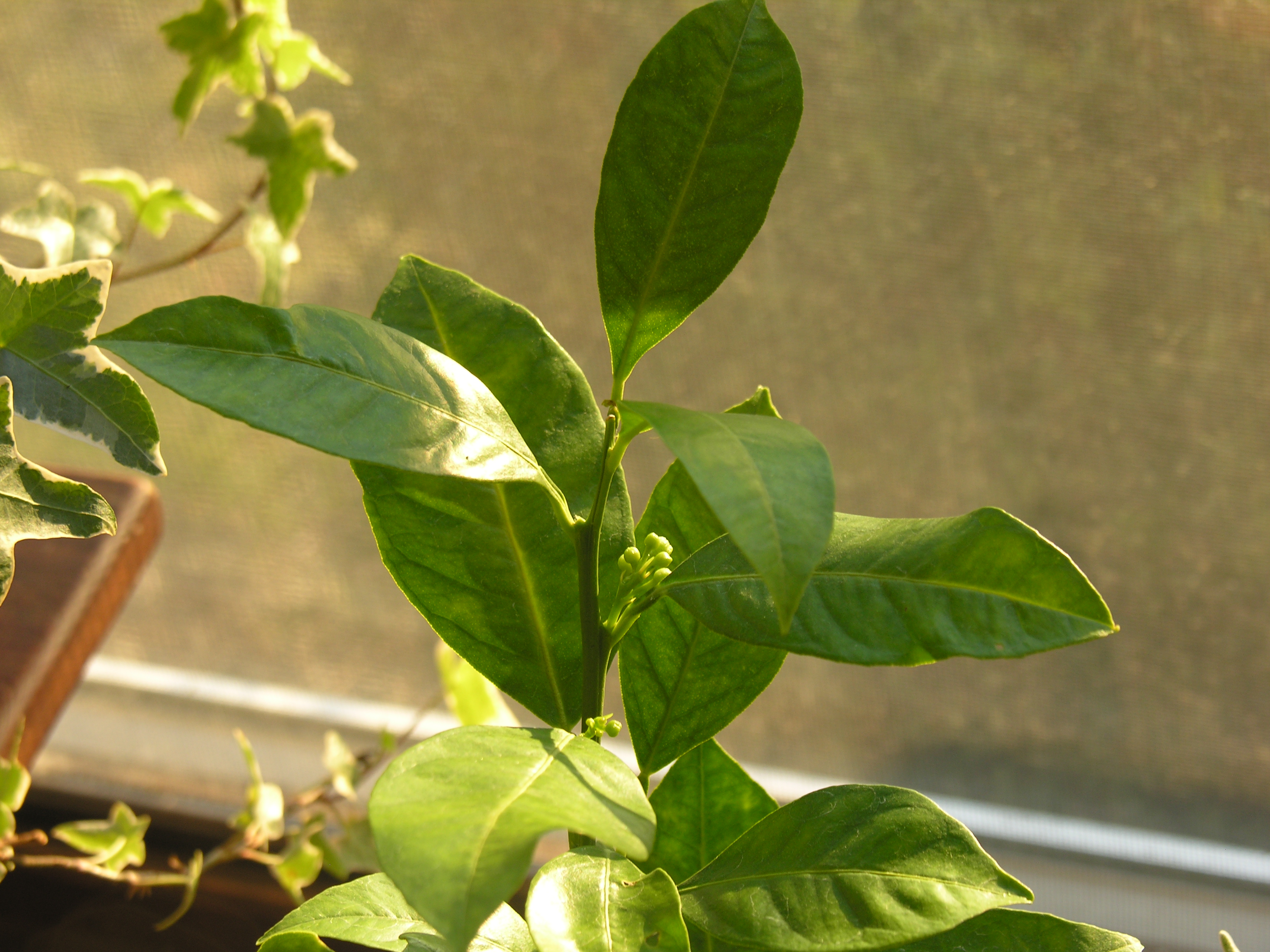
And I would be remiss if I did not give a most honorable mention to my lemon tree. In my last letter, I lamented your stagnation and general lack of enthusiasm.  I was actually thinking of giving you away to HerbDoc, who said she would try to “persuade” you to grow. Well, imagine my surprise when I peered down at you recently, and there they were: little buds at each node. It looks like you’re going to flower – and rather soon! Good going, and you are most welcome for the chelated iron.

Yours Truly,

Your Caregiver

My lemon tree. Check out those buds!

Posted in Uncategorized | 4 Comments

Really Fresh Produce

Here’s HerbDoc with some thoughts on where our food comes from:

I read an interesting quote the other day which made me reflect on what we buy and from whom.  The quote said:  “Living sustainably isn’t only about what you use, but what you fail to use.”

How many times have you purchased fresh produce at the supermarket only to have it spoil before it can be used?  Most produce in the US is picked 4 to 7 days in advance and travels some 1500 miles before it ends up on the market shelves. Distances are of course increased when we buy imports from South America, Mexico, Asia and the like.  Did you know that 90% of all produce is the US is shipped by truck and that this contributes to about 1% of all the emissions generated by trucking?

In addition to the poor quality of food and pollution of the air by freight trucking, large agri-businesses use enormous amounts of fertilizers and pesticides to get crops to market.  These contribute to the destruction of our soils and water and generate health scares every year such as e-Coli and GMO contamination.

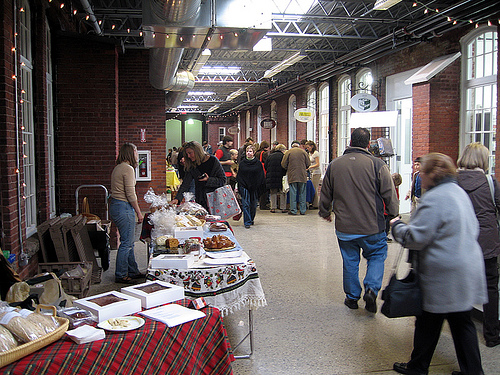
We can all help by buying locally grown food whenever possible.  Farmers’ markets have sprouted up all over Rhode Island, and some are now open year round.  The nearest farmers’ market to my home is less than a 10 minute drive, and on any given Saturday from 10 AM to 2 PM offers fresh vegetables, beef, shellfish, pastries and breads, cornmeal, honey, jam and whatever else is in season.  The aroma of johnnycakes hot off the griddle and that fresh bread is irresistible!

photo: Farm Fresh RI

When we purchase produce at a large supermarket only 18 cents of every dollar goes to the grower while the other 82 cents goes to various middlemen.  Let’s cut out those middlemen, buy our food directly from a local grower, and keep the business and dollars in our own communities!

Posted in Uncategorized | 4 Comments

Greening the Roof

a green roof in New York City

I love the idea of a building that not only does not harm the environment, but actually contributes to it in a positive way. Green roofs help do that. Proponents of green roofs insist that when integrated with other environmentally sustainable building practices, green roofs can reduce heating and air conditioning costs, filter and clean the water and the air, make use of local and recycled materials, extend the lives of roofs, provide habitat for wildlife and green spaces for humans, and just look really pretty.

Isn't this beautiful?

The average roof is a stark, forbidding place. Green roofs, on the other hand, are vegetated roof covers that provide additional living spaces and a way to connect with nature.

Just in case you thought this was something new, it’s not. Green roofs go back many hundreds of years. (Ever heard of the hanging gardens of Babylon?)

The development of today’s green roofs began in the 1970s in Germany, where they are now commonplace. Finally, about 20 years later, people started building them here.

There are two types of green roofs: extensive and intensive. Extensive roofs are more lightweight,  with fewer types of plants – mostly alpine. They are not usually accessible to people. Intensive roofs are higher maintenance, and can be planted with a wider variety of  trees and shrubs. These roofs are also designed for human recreation.

I would love to see green roofs catch on in a big way here in Rhode Island. We have a perpetual problem with storm water runoff, and we could use all the help we can get.

Interested in greening your own roof? Go here for information and ideas.

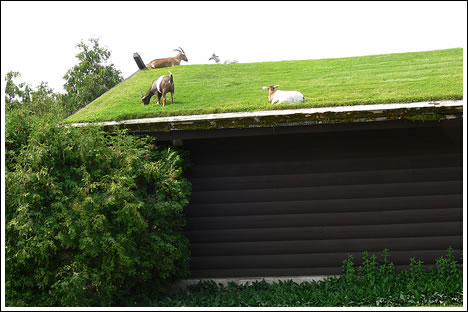
Goats on your roof. How cool is that?

Posted in Uncategorized | 2 Comments

Tomato Poll

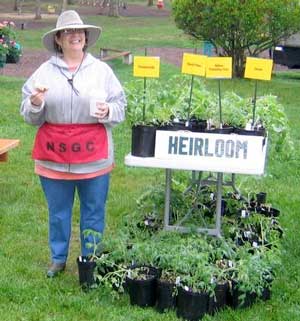
Garden geek Auntie Beak, wearing her other hat (literally) as Tomato Captain of the North Stonington Garden Club.

Dirtynailz’s garden catalog post, below, which mentions the Totally Tomatoes catalog, prompts me to mention my own very happy experiences with Totally Tomatoes.

I love heirloom tomatoes. No, really, I LOVE them. And Totally Tomatoes has a great selection. Now, besides being the DiggingRI resident garden geek, I am also a member of my local garden club, just over the border in North Stonington, Connecticut. We hold just one fundraiser a year, which is a massive Plant Sale, and as part of that sale, I run a Tomato Poll. The poll has lots of heirloom varieties from Totally Tomatoes, and allows anyone to vote for their favorite heirloom tomatoes, which we then raise for our sale.

I realize you all will probably have lots of choices for plant sales to visit this spring, including the East Farm Festival, which is always on the same day as my plant sale. But if you love heirloom tomatoes like I do, you’ll surely want to make some time to visit the North Stonington Garden Club’s sale too. No reason, really, why you couldn’t hit both!

Especially if you voted for Cherokee Purple and Lemon Drop.

Posted in Uncategorized | 10 Comments

Flowers That Aren’t

Have you ever seen a “frost flower?” I think I might have seen them in the woods when I lived in Quebec, but I haven’t seen any since I moved to RI.

a frost flower

Frost flowers need specific conditions in order to form: wet soil, followed by clear night skies and a drop in temperature to 28F or lower. They form in the fall on the stems of plants when water supercools inside the plant stems. Capillary action draws moisture up through the stems and that moisture freezes, splitting the stems and freezing on contact with the cold air. As more water is forced out of the stem and freezes, the accumulated ice forms ribbons that twist into “petals” and flower-like shapes.

Some plants are known for producing frost flowers. Ironweed (vernonia altissima) and dittany (cunila mariani) are two of them. You won’t see this phenomenon once winter sets in, because frozen water won’t travel up the plant stems. (I thought these were so unique that I’d share them with you anyway.)

Not surprisingly, frost flowers are so delicate that they usually shatter when touched. However, as morning temperatures begin to rise, they are more likely to melt and disappear before we ever get to see, let alone touch them.

Posted in Uncategorized | 6 Comments

My Favorite Things II: More Catalogs!

It’s my turn to weigh in on my favorite catalogs. Like HerbDoc, I am always pleased to see them waiting in my mailbox. I set them aside and savor them later, often before going to sleep. (I find reading about plants and thinking about the garden very relaxing.) Then when I decide it’s time to get myself in gear, I haul them out of their special storage box and start making lists – and plans. I enjoy growing plants from seed (so miraculous!) and I love my Lee Valley seed starting system. It has capillary mats, so the seedlings are supplied with a constant level of moisture.

Anyway, back to the catalogs.

I always enjoy the beautiful catalogs from White Flower Farm. The photographs are top quality, and I learn a lot from reading the descriptions of the plants. I also really appreciate the fact that they write out the botanical names phonetically, so you know how to pronounce them. By the way, I don’t like catalogs that do not print the botanical names.

Another favorite is High Country Gardens. I like their low maintenance and drought-resistant offerings. Most of the cultivars are also hummingbird magnets – important to me.

Like so many others, I, too love the Bluestone Perennials catalog. I have ordered plants from them and they have always arrived in perfect condition.

For bulbs, both spring and fall planting, McClure and Zimmerman has a great selection.

I have a thing for clematis, and there’s a great nursery in Ipswich MA called (appropriately) “Completely Clematis.” Their catalog is online only, and the selection is mind-boggling. I have ordered from them several times and the quality is excellent.

For vegetables, I like “The Cook’s Garden” but for tomatoes in particular, I love “Totally Tomatoes.” The name of the catalog says it all (although they also sell pepper, eggplant and cucumber seeds).

Posted in Uncategorized | 4 Comments

My Favorite Things : Catalogs!

HerbDoc shares some of her favorite garden catalogs. Please feel free to share yours!

This is a wonderful time of year for gardeners.  Last year’s gardens have been put to bed, and the seed, nursery and tool catalogs have been stuffing my mailbox since just after Thanksgiving.  Is it just me, or were they extra early this year?  Now with snow on the ground and the holiday decorations put away, it’s time to sit down with last year’s notes, my box of saved seeds and the bounty of catalogs to plan the new season.

Since I’m heavily into herbs, heirlooms and sustainable plantings and practices, some of my favorite publications are:

1) Richters (Goodwood, Ontario LOC 1A0 Canada).  This 75 page catalog is a bonanza of almost every known herb, has great zone and historical information and wonderful products and books.  Plants or seeds are available.

2) Johnny’s Seeds (955 Benton Ave., Winslow, Maine 04901-2601).  Johnny’s is an employee-owned company that offers vegetable, herb, flower, fruit and cover crop seeds along with superb products and tools.  Valuable growing information is provided for each entry.

3)  Seeds of Change (c/o Marketing Concepts, PO Box 152, Spicer, MN 56288).  This company supplies only heirloom, open-pollinated and traditionally bred modern hybrids (no GMOs!); all are organic.  Owners believe that “Seed is the first link in a safe food chain.”

4)  Baker Creek Heirloom Seeds (2278 Baker Creek Rd., Mansfield, MO 65704).  This is an absolutely spectacular catalog filled with gorgeous photos, great descriptions and customer reviews for each listing.

5)  Gardens Alive! (5100 Schenley Place, Lawrenceburg, IN 47025).  All products offered are environmentally safe and all natural.  You’ll find products for your home, lawn, garden and pets, all of which have a 100% money back guarantee.  If you order by March 3rd, you’ll get $25 off your (no minimum) order!

Two others that I couldn’t do without are Heirloom Roses (24062 NE Riverside Dr., St. Paul, OR 97137) which offers virus-free, winter hardy, own root roses from a very knowledgeable staff and Lee Valley Tools (PO Box 1780, Ogdensburg, NY 13669-6780), another Canadian company, that sells innovative, high quality tools for woodworking, gardening, and cooking as well as hardware.

All of these companies have on-line sites and some, like Johnny’s and Seeds of Change offer free email newsletters and updates.  I subscribe to these, but I just have to have to feel and smell  the catalog paper (with a huge bunch of stickies nearby!) to mark my favorites!

Posted in Uncategorized | 5 Comments

A Peek at the New Perennials

Before the holidays,  the Rhode Island Master Gardeners were treated to a talk by award-winning garden writer, lecturer and plantsman extrordinaire, Graham Rice.

Graham Rice

Graham divides his time between Pennsylvania and England. He is  the author of numerous gardening books, and the Editor-in-Chief of the British and American Encyclopedia of Perennials. So it’s probably a gross understatement to say that this is a man who really knows his plants, and even better, knows which growers are growing what and which introductions we are likely to see this coming summer.

I have always thought that our preferences for certain plants are very subjective –  matters of personal taste. For instance, I usually go for the old- fashioned cultivars and single flowered varieties over the fluffy and flashier new doubles.

I am not overly fond of some of the new echinaceas, but of course, many people would disagree. However,  I  did fall head over heels for some of the new rudbeckias when they were introduced a few years ago, particularly “Prairie Sun.”

Dicentra "Burning Hearts"

Many of the new perennials are the results of someone spotting a sport growing alongside its wild or nursery buddies, and propagating it. Graham explained that growers usually wait a few years to see if the new cultivars will breed true. Many times they do not.

There are some mighty interesting things being done with foliage and flowers. We were treated to some great “garden porn” – beautiful photos of new heucheras, hostas, dicentras etc.

Dianthus "Wicked Witch"

For more information, check out Graham’s blog, “The Transatlantic Plantsman.”

Posted in Uncategorized | 4 Comments