North of the Border

DSCN4928

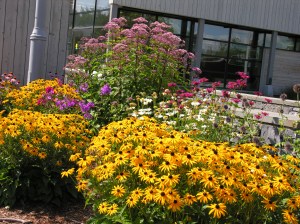
I’m just back from a quick trip to Canada. It’s amazing how just a few days away from home can feel like weeks.  I drove up to Quebec alone, stopping once in a while to stretch my legs and admire scenes like this – the flower bed at the Williston, Vermont rest stop. What a great display of sustainable plants – everything from rudbeckia and echinacea to phlox, monarda and eupatorium. The plants were thriving, probably because of all the rain.

I was staying in Mont St. Hilaire, less than 20 miles southeast of Montreal. The focal point of the community is the mountain, which rises up out of the flat land quite abruptly, to a height of 1,358 feet.  In 1978, it was recognized by UNESCO as a biosphere reserve because of its unique ecology which includes some of the last remaining virgin forest in the region, and many unique animal and plant species.
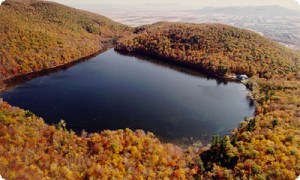
Lake Hertel, near the top of the mountain

Lake Hertel, near the top of the mountain

It is also a federal migratory bird sanctuary.

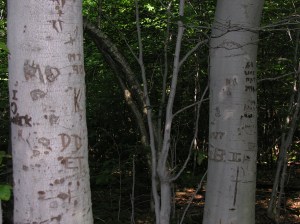
One morning, I decided to hike one of several trails that explore the mountain. It was going to be a hot day, so I started out early, and took the “Pain de Sucre” or “Sugarloaf”  trail that went to the top. The trail climbed steadily through the forest, which includes trees that are hundreds of years old. Many of the beech trees closest to the trail had been vandalized – something that drives me crazy. DSCN4970
It took me just over an hour to reach the top. The upper part of the trail was very rocky, and when I finally got to the summit, I was greeted by a knotted rope embedded in the smooth rock dome.
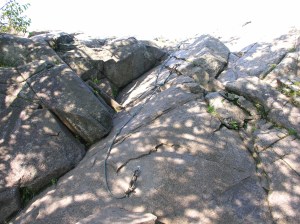
gnarly!

gnarly!

This was the only way I could haul myself up to the final section – the part with the view –   and I sure wasn’t going to miss out on that after all the huffing and puffing it had taken to get me up there. The specks in the photo below are flies. There were hundreds of them hatching, which made resting at the top less than appealing.
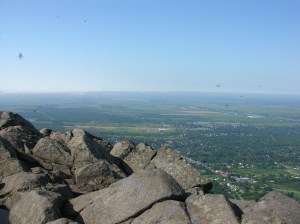
Worth the climb!

Worth the climb

McGill University administers the Mont St. Hilaire Nature Centre, which guarantees public access to certain areas, while much of the mountain remains a true preserve, permanently closed to visitors. It’s a real treasure for visitors, scientists, and especially the flora and fauna that  live there.

Posted in Uncategorized | 2 Comments

Tomatoes…Gone But Not Forgotten

Fungus damaged tomatoes...slim pickin's.

Fungus damaged tomatoes...slim pickin's.

Well, here we are in August and I thought it would be a good idea to see what happened to the tomatoes after my earlier blog about late blight. Unfortunately, the story is not a good one, as most of us already know.  The disease has been striking home gardens to be sure but crop loss by produce farmers in New England is a more serious problem. Of course, organic farmers were hit the hardest because they cannot use the strong, synthetic fungicides that work best to protect their harvest. Recent figures show that at least 400 farms have been affected by late blight in New England. Plant disease specialists say they believe infected tomato plants sold to home gardeners by big box stores are also responsible for how rapid and extensive the outbreak has been.

 Now, there are home gardens that have not been hit by late blight but even for these fortunate gardeners the tomato plants have made it clear that they do not like the weather this year. Plants were affected by the usual fungus problems we get every year but everything was worse this year because of all the rain. And yet some gardens have been perfectly “normal” and will deliver the usual abundance of those long-awaited, mouth-watering, delicious treasures that we wait ten or eleven months to enjoy.

 For those unfortunate home gardeners who will harvest no tomatoes this year I share your pain. But look at the abundance of other fruits and vegetables produced in your garden and celebrate the harvest! I am having a bumper crop of zucchini and butternut squash … lettuce and chard has been great (why not with all the rain and cool weather) … peas were fabulous even though I planted them late … and the red cabbage and onions could not have done better. Only my cucumbers are limping along and yes, I am even starting to see eggplants – in abundance. So the tomatoes will have to be a fond memory until next year but the table is overflowing!

Posted in Uncategorized | Tagged | 2 Comments

Do You Vine Ripen?

I just came across an intriguing post on the Your Small Kitchen Garden blog: The Vine Ripened Tomato Lie. With a title like that, I had to read on! Here’s an excerpt:

Earlier I said, “…unless you have absolute control over how much rain falls and how often…” You do have such control! Quite simply: don’t let your tomatoes ripen on the vine. When pink first appears on a tomato’s skin, pick the tomato and set it inside out of direct sunlight.

The central premise is that leaving tomatoes on the vine to ripen a) doesn’t make them any tastier, and b) risks all sorts of damage, like cracking and green shoulders. It’s a radical concept, but the pictures will be familiar to any of us tomato gardeners…

27920cfd0218d2a

As we say in the blogosphere, go read the whole thing.

Posted in Uncategorized | 3 Comments

August is Asian Longhorn Beetle Awareness Month

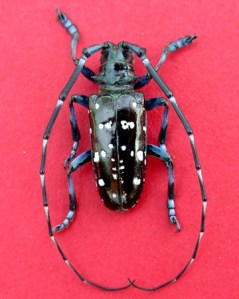
Imagine watching crews cut down every single tree on your street. Now, imagine living in Worcester, MA, where they’ve had to destroy about 25,000 trees so far. The culprit is this  creature, the Asian longhorn beetle or ALB, and it could be coming soon  to a forest near you.

Asian longhorn beetle - male

Asian longhorn beetle - male

After hitching a ride in wooden pallets, these insects, which come from China and Korea, proceeded to decimate trees in New York, Chicago,  parts of New Jersey and Toronto, Canada. Now they’re here in the Northeast, and if they spread, they could destroy forests from New England to Canada.

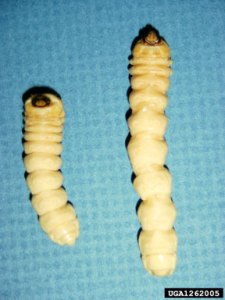
The beetles lay their eggs just under the bark, and the larvae spend the winter feeding on living tree tissue like heartwood.

ALB larvae - photo Michael Bohne

ALB larvae - photo Michael Bohne

In mid-summer, (just about now) the beetles emerge from perfectly round holes, which are about the size of a dime. The host tree is killed in a couple of years. Officials are trying to eradicate the ALB with pesticides and  by cutting and chipping all trees in  affected areas.

Now, here’s the really scary part: firewood. The USDA estimates that the beetle went undetected in Worcester for at least ten years. That means firewood from the affected area was probably transported to other parts of New England. Here in Rhode Island, we’ve already had a problem with ALB-infected firewood. Two RI companies were fined nearly $2,000 each for transporting 11 ash trees from the quarantined area in Worcester to North Kingstown. A bill has been introduced in the RI Senate that would make this a crime, and raise fines to up to $25,000. ALB-infected firewood was also found at a home in Cranston. The homeowners had brought the wood from their property in Worcester.

Officials admit that it’s highly likely that the beetle has already escaped from the quarantined area. The question is, where will it show up next? With one third of the trees in the northeast at risk, the stakes are frighteningly high. People like us – gardeners who care about trees – can help by doing two things: first, if you use firewood in your home or while camping, buy it locally – never transport it. Second, go to this USDA website to learn how to recognize the Asian longhorn beetle and to find out what to do if you find one.

Cornell University  also has  an excellent  diagnostic website to help you determine whether you have Asian longhorn beetles on your property.

Posted in Uncategorized | 4 Comments

I Give Up

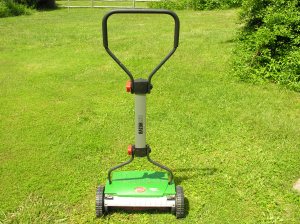
The Brill, in happier days

The Brill, in happier days

Back in June, I wrote about my new push mower. I said that this mower and I were in the process of developing a “working relationship,” and I went on about the money I was saving and how my garden would no longer be decimated by the landscapers’ trimmers.  I also wanted to use something environmentally responsible, and I wasn’t opposed to the exercise either.

What I didn’t know was that this summer in Rhode Island – so far anyway- would turn out to be the wettest summer ON RECORD, and that I would be able to look out at my lawn and practically see those evil blades of green growing before my very eyes. That meant I had to mow every week without fail, since the mower can’t handle longer grass. It’s been really hot and muggy, too, and I started to dread my mowing sessions. Even with my  favorite podcasts to entertain me, I found myself getting really irritated by the entire process.

I perservered, because I am not a quitter, and even more importantly, because I knew I would get the whole “I told you so” rap from my husband, who never got within 10 feet of the mower himself. He had told me that our lawn was probably going to be too big for the mower to handle easily, and gosh darn it, he was right! It was such an effort to push that thing in the areas of our lawn that had grown a little faster. Even with the blade set at the longest cut, I was still having trouble.

A couple of days ago, I looked at the front lawn that I had mowed only two days earlier, and it was already looking a bit scruffy. I thought of how I was going to sweat and strain for an hour and a half to cut it again. Then, two doors down, I saw the landscaper arrive with his big gas guzzling professional mower to cut my neighbor’s lawn. I shamelessly trotted right over and asked him if he could start cutting our lawn beginning next week.

I caved, and I know my husband will rag on me a bit, but I don’t care. I will either keep the mower for a time when we have a smaller lawn, or I will find it a good home. Either way, I’m free!

Posted in Uncategorized | 3 Comments

Hydrangeas Aren’t Perfect

Hydrangea macrophylla...blue lace and Nikko blue in full bloom.

Hydrangea macrophylla...blue lace and Nikko blue in full bloom.

There is something about a hydrangea that is almost irresistible…maybe it’s their reputation for being old fashioned…something my grandmother would grow. Until this year I also thought hydrangeas were nearly indestructible. There are four hydrangeas growing along the side of my porch, all are macrophyllas – two lacecaps and two Nikko blues – and they have thrived for seven years without fail. Then this spring, when I went out to do the usual pruning, I noticed the Nikko buds were frozen and the stems were mostly dead. I couldn’t imagine what had happened.

Well, Nikko blues are only winter hardy to Zone 6. OK, I am in Zone 6, so what happened? Well, for one thing we started to warm up in the spring but then it got cold again and very, very windy. Also, it seems that for one single day last winter the temperature fell to one degree below the lowest average temperature for Zone 6…ONE DAY!…ONE DEGREE!…so without protection a significant number of flower buds froze  and there were very few blooms this summer. But an odd thing happened: there are new stems that grew up from the bottom of the plant and they now have small flower buds. But wait…Nikko blues only bloom on old wood, don’t they? Hmmm.

There is one other thing about Nikkos. They are water hogs. I always knew this but you would think that in a month when there was more than 11 inches of rain it would not be a problem. (And yes, I have beautiful loam, not sandy soil.) So guess what. They still drooped when there was no rain for a couple of days. Doesn’t matter, maybe they aren’t perfect but they are still irresistible to me.

Posted in Uncategorized | Leave a comment

Milkweed Matters

DSCN4803Isn’t it beautiful? Do you have this in your garden? I let milkweed grow around my potato patch. I yank it if it starts growing inside the fence, but around the perimeter, it’s just fine. This is, of course, common milkweed, or asclepias syriaca.
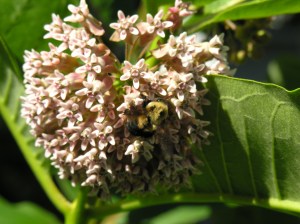
DSCN4802

I think the flowers smell wonderful. I just wish the plants didn’t have a tendency to fall over in a strong wind.

Milkweed is not only crucial to the monarch butterfly, it is also important to other pollinators like the bee in the photo on the right.  It seems that people are destroying milkweed at an alarming rate, and there are campaigns to save and propagate the plants.

A "Save Milkweed" campaign in Minnesota

A "Save Milkweed" campaign

Milkweed is the only plant the monarch butterfly lays its eggs on, and it’s the only thing the monarch caterpillars eat. At this time of year in Rhode Island, you can often find the small whitish eggs on the undersides of milkweed leaves. When the caterpillars eat the leaves, they ingest the “milk” or latex, which renders them inedible for most predators. They’ll chomp away for about three weeks before entering the pupa stage, and will grow 2,700 times their original size during this period! Below is a photo I took of a monarch caterpillar on one of the milkweed plants in my garden. It didn’t take much effort on my part to provide a place for it to eat and grow.DSCN2399

Posted in Uncategorized | 3 Comments

A Couple of Critters

I’ve had two visitors in my garden recently – one common and the other less so.

In our area, the squirrel population is completely dominated by the “grays.” That’s why I was surprised to see this unusual  little red squirrel in my crabapple tree.DSCN4790

If I had to guess, I’d say he  was checking out the nesting box to see if there was any tasty protein in there. No luck this time. The box is empty.  I haven’t seen him since.

To the great chagrin of some of our neighbors and family members, we have always had snakes that like to bask on top of the shrubs at the front of the house. They are all common garter snakes, or Thamnophis sirtalis.

We welcome them in our garden because they help control pests, and they keep away the “ophidiophobes,” or the snake-phobic, most of whom we don’t like  anyway. According to the RI Department of Environmental Management, there are NO venomous native snakes in Rhode Island, so their hysteria is all for naught.

DSCN4915

I don’t know why, but I have a feeling this large garter snake is a female. I see her early every morning (unless it’s raining) always in the same spot on the same shrub to the right of our front entrance. When I walk outside with my dog, she just stays right where she is. Once in a while she’ll flick her tongue, but usually she does nothing. She is always gone by 9 am.

I am debating whether to tell the new owners of this house about our snakes. I don’t want them to be taken by surprise and overreact by killing them, but I don’t want to take the chance of scaring them in advance either.

I have read that the course of evolution has endowed humans (and many other animals) with an innate fear of snakes because we had to protect ourselves from the venomous ones. But our brains evolved, too, didn’t they? So we should be able to avoid the dangerous snakes and leave the harmless and beneficial ones alone.


Posted in Uncategorized | Leave a comment

The Grass is Blue!

Recently, I had some visitors at my home and in the course of conversation we ended up talking about lawns. One of the fellows asked me how I managed my lawn to keep it so thick and green. My answer surprised him…and disappointed him as well. 

My grass is green...and it isn't bluegrass.

My grass is green...and it isn't bluegrass.

Here’s my secret…do almost nothing! Plant a good quality fescue mix with a little perennial rye and Kentucky bluegrass thrown in, fertilize once a year in September, put down crabgrass preemergent in early spring, and water only if you really can’t tolerate a few weeks of browning during the peak summer heat. Reseeding every fall until the lawn is as thick as a carpet is the best way to keep weeds out.

 After explaining all of this I pointed out that the net result is a lawn that is beautiful, functional, and care free. That was the clincher for him…care free. He told me that  using high maintenance bluegrass was the only way for him to go because he could spend a lot of time caring for the lawn and it looked like a golf course. Yes, I said, and this means extreme water usage, higher cost, endless work, and more potential for disease. Not a problem, he said.

We all have to make choices, I suppose, but being green does not mean being blue.

Posted in Uncategorized | Tagged | Leave a comment

Hot Summer Reading From Garden Writer Amy Stewart

Amy Stewart

Amy Stewart

If you haven’t read Amy Stewart’s books, you might want to check them out.  Her latest , “Wicked Plants,” takes a detailed look at the  poisonous,  illegal, and generally evil members of the plant world. Her earlier best-seller, “Flower Confidential,” is a fascinating description of the nursery industry, especially the global cut flower business. She is also the author of two other books of interest to gardeners, both of which I enjoyed reading,  and she can be found on the blogs “Garden Rant “and “Dirt.”

Now, Amy has written what she calls “an experimental novel” that I thought you might want to know about. It is entitled 6a00d8341c6d6753ef011570d6d36d970c-120wi “The Last Bookstore in America” and there are some juicy garden bits in this book, too. The story takes place in California and revolves around the demise of bookstores in the digital age, and the cultivation of  a very popular and about-to-be legalized crop.

Amy is calling her book a “novel in progress,” and for now, it is available only in electronic form. You can download a copy here or here. She is also welcoming comments – the more the better!

Recently, I asked her a few questions about the novel:

Given the subject/theme of the novel, why did you choose to release it electronically only? Deliberate irony, just being practical, or testing the waters?

“My idea was this:  writers work in relative solitude, and we get little feedback on manuscripts in progress.  My brother works in Hollywood and he can screen a film in front of a test audience.  This doesn’t happen in the book world.  I can send a manuscript out to friends and colleagues for feedback, but it’s far more interesting to find out what complete strangers think.  The problem is, I don’t know any strangers.  So I thought that by putting it out there in digital form I could get feedback quickly.  It’s a great use of this technology.

It’s also true that the novel itself is about digital books, so I did think that people who already have a Kindle or use Scribd might be even more interested in the subject matter.  Also, the book deals with two very timely issues:  the rise of the digital book and the legalization of pot.  Releasing it in some form now, rather than waiting two years for print publication, seemed to make sense given how current these issues are.  Digital publishing allows a book to get into the world right away, and that does appeal to me.”

Are you planning a paper copy?

“Sure.  I’m working on it.  It will make the rounds of publishers in the usual way–but not before I incorporate some of the great feedback I’m getting from readers through this process.  I see this digital edition as a near-final draft, a beta test, and I will definitely do some fine-tuning based on what readers are telling me.  It’s very hard for a writer to get a fresh sense of, for example, whether something is suspenseful or surprising.  I already know what’s going to happen, so I don’t get to experience it with fresh eyes the way readers do.”

You have said that writing this was really fun because you had more freedom with fiction. Does that mean you’ll be writing more novels?

“I hope so.  I love fiction.  When I’m reading just for pleasure, not for research, I always read fiction.  As a nonfiction writer, I’m really more interested in the stories and characters and drama.  That’s why I’ve never written how-to gardening books.  I’m less interested in information and more interested in stories.”

That garden where the marijuana and other plants were growing sounded so idyllic. I think many gardeners would find the passage where Edith destroys the plants quite painful. Was it painful to write, especially in such detail?

“I loved writing about that garden, and especially about tearing it up.  Gardening can be quite violent, really.  I know so many gardeners (including myself) who have gotten hurt trying to dig something up or tear something apart.  I would like to have more of the garden in the book, actually, if I could figure out where to put it.  Maybe that will happen in the next round of revisions.”
Posted in Uncategorized | Leave a comment