Permanent Houseguests

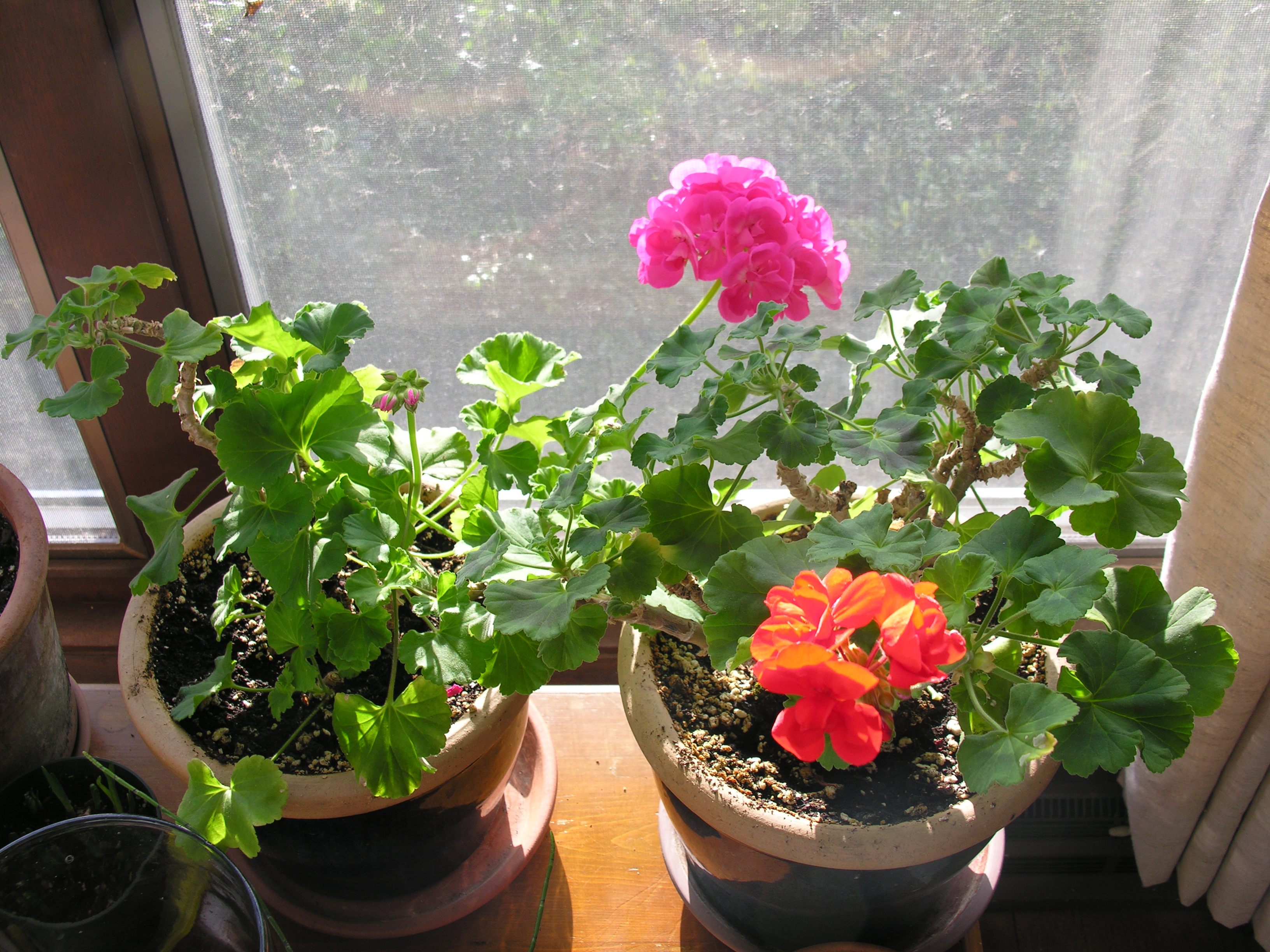
Behold my humble geraniums. They were not always mine. I do not grow these in the summer. My mother-in-law grows them though, and at the end of the season there is always one she can’t bear to throw away. The first year, under extreme pressure, I agreed to overwinter the pink one. The next year, she begged me to do the same for a red one. The thing is, they just stayed, and never saw her garden again.

Since my success with these, my mother-in-law has tried to persuade me to take other plants of hers – even bedding plants such as begonias and impatiens. (She is  unclear on the concept of annuals.) But I stand firm and draw the line. Two geraniums it is and will forever be. In my sunny living room window they sit, taking up a fair bit of precious houseplant space. To be fair, they rarely stop flowering, and they do bring a summery touch to the room.

Do you find that once people know you are a gardener, or at least proficient with houseplants, they tend to bring you their unwanted and ailing plants so you can “rehab them  for a while?” Sometimes, they don’t even bother with that ruse. They just hand you the plants and tell you to keep them or throw them away. And you know what comes next: finding a spot to quarantine the newcomer, which is invariably infested with something  highly contagious, and finally, the feelings of guilt when you eventually do have to throw it away.

At least these geraniums are healthy.
Posted in Uncategorized | 3 Comments

Rosemary is for Remembrance

In the third of her series of posts about common herbs, HerbDoc has some thoughts on one of the most popular – rosemary:

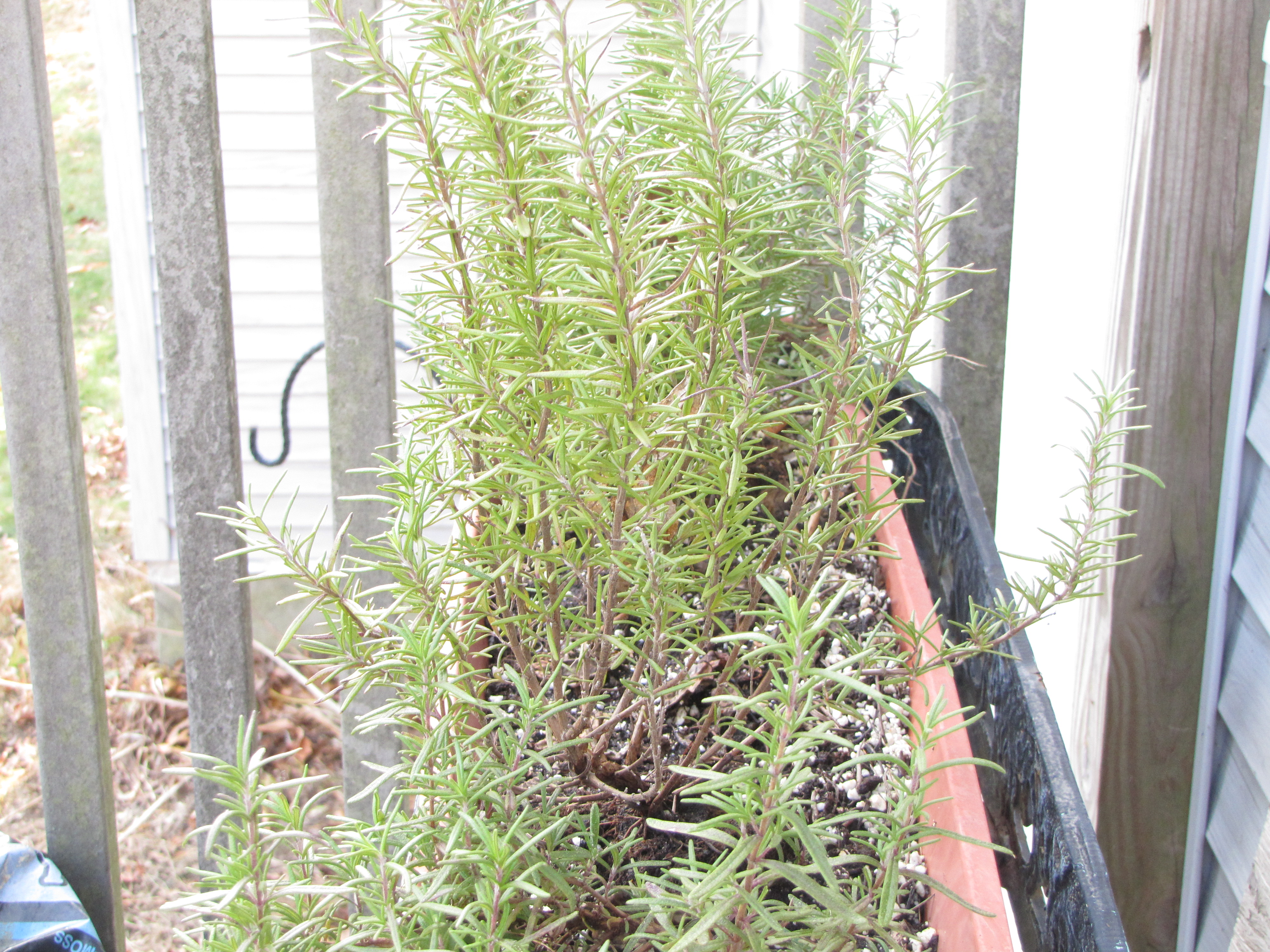
One of my favorite herbs, rosemary, is still doing well outdoors even though temperatures have dipped as low as 12 degrees here in RI.  Most herbals note that upright rosemary, Rosmarinus officinalis, cannot survive temperatures below 27 degrees so I can only speculate that the ones that make it through the winter either have adequate protection or are drawing on the escaping heat from my home.

Rosemary, defying the cold

Rosemary is a symbol of remembrance and fidelity.  It was often placed in bridal bouquets and given to wedding guests as a reminder of constancy and devotion.  It was also strewn on graves in the promise that the deceased’s good works would not be forgotten.

As a medicinal it was said to cure nervous ailments and to restore youth to those who merely smelled its aroma.  Hungary water, a concoction of alcohol (“Melasses spirit”, perhaps dark rum) and rosemary tops were heated and distilled to produce a rubbing ointment for lame joints.  According to legend an old hermit made this medicinal to cure Queen Elizabeth of Hungary of paralysis.

In today’s kitchen, rosemary is indispensable for flavoring soups, stews and meats.  Although it can be used in dried form, cuttings of fresh growth can be laid on roasts to add a wonderful flavor.

One caution:  Although many stores and shops sell fresh plants at this time of year, rosemary is usually not fond of the temperature and lack of humidity in today’s homes.  Rosemary hates to be dehydrated so the ones that are lucky enough to make it to the springtime in my house are grown in a cool basement room at a window.  Here they receive adequate light and a weekly watering and misting of their needle-like leaves.

Posted in Uncategorized | 4 Comments

Pomanders

Pomanders

In this first post of 2011, HerbDoc talks about pomanders, and how to make them:

Ahhhhh!  I love the spicy scent of pomanders and try to make several every few years.  What we think of as pomanders today, oranges studded with whole cloves, is a far cry from what they were originally made of.

Because there were so many obnoxious odors in medieval society (think rotting garbage, open sewers, etc.), the upper crust would wend their way through the streets daintily sniffing their pomanders in lacy hankies.  They believed their scented herbal would protect them from disease and pestilence.  These pomanders were often made from beeswax or soil balls and were imbued with herbs, perfumes and spices.

Here’s how to make modern day pomanders.  Buy several fresh oranges (or any citrus fruits) that are free from blemishes, whole cloves, and spices.  I prefer to cover the entire fruit with cloves and find that it takes about 1 ½ – 2 ounces of whole cloves per orange.  To save funds, buy the whole cloves and your favorite spices at the local dollar store!

Use two bowls.  One will be the receptacle for the orange and the other will hold the cloves.  If you try to use one bowl for this work, it will become a huge sticky mess!  Although my original directions called for using a large needle or an ice pick to make holes in the fruit, I’ve found that using a four-tined fork makes the work easier.  Make 4 – 12 holes spaced evenly apart and insert the cloves.  It’s best to go around the circumference of the orange in two directions and then fill in the areas so the fruit will not split.  Plan to finish each pomander in one sitting and immediately transfer it to a platter to be dusted with cinnamon, a bit of nutmeg and ginger.  Orris root can also be used as a preservative if desired, but if the cloves are placed closely together and the fruit is dusted in spices, my pomanders last many years without it.

Once the pomanders are completed and have dried for three to four weeks, they can be enclosed in netting and tied with ribbon.  The scent is heavenly and is a wonderful addition to closets and drawers.  One aside…if you plan to display them, make more than you need.  Everyone will want to take one home!

Posted in Uncategorized | Leave a comment

A New Year’s Wish

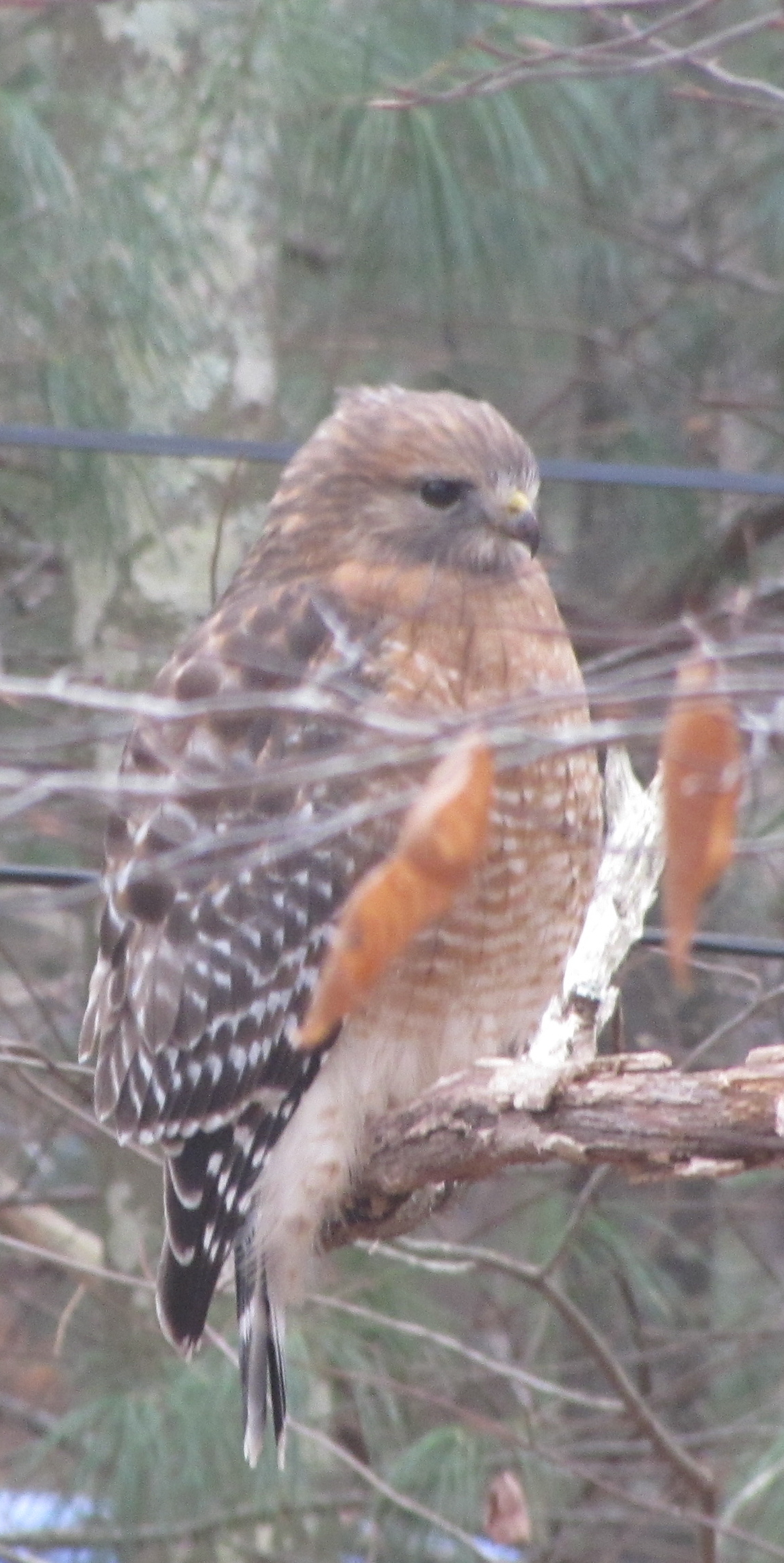
Awesome, even seen through a window!

HerbDoc recently had an unexpected – and welcome – visitor to her garden:

It’s common to see various owls and hawks in this area, but I was amazed to look out my window the other day and spot this Red-shouldered Hawk (Buteo lineatus).  It was the first time I have seen this hawk in my yard, and it sent me scurrying to my field guide to identify him.  These birds are 16-24 inches tall with a breathtaking wing span.  He was sitting quietly on a low branch looking for dinner which I understand may be insects, small mammals, and in the better weather, frogs and snakes.  As I watched he hopped down to the ground and proceeded to jump rapidly up and down, returning to his branch to dine on what I presumed was some sort of insect.

These raptors love deciduous woodland, especially where standing water may be present.  My guide tells me that they are quite vocal, emitting a shrill kee-yeer, but this bird made not a sound.

Many Native Americans believe that the hawk is a symbolic messenger.  I hope that his message at this time is for a happy, healthy and peaceful 2011 for all of our readers and contributors!

Posted in Uncategorized | 6 Comments

The Wait is Over

“Be careful what you wish for!” my oh-so-funny friend warned, and of course, she was right. It was not even a week ago that I was writing wistfully about waiting for snow. Yesterday and last night, we got it – about a foot here on the Rhode Island coast along with very strong winds – a true blizzard in the meteorological sense. It must have also rained at some point, because there’s a crust, making shoveling and dog walking tiresome.

Looking out past the garden to the salt pond.


I installed the ice carpet on our stairs just in time. This year, I used roofing nails, which have wide rubber gaskets around the heads. These hold the carpet in place and prevent tearing. All I had to do this morning was brush the stairs lightly with my boot. The very thin layer of snow that had accumulated just drifted away and I was left with a nice, safe staircase. When I was in Canada last summer, I bought two lengths of carpet – one for the coming winter and a spare. The stuff they use up there is much sturdier than the cheapo one I bought last year from a catalog here in the US. That one shredded before winter was over.

So we’re all cozy and ready for whatever winter brings. I am just grateful we’re not traveling in the next few days!

Posted in Uncategorized | 8 Comments

Parsley: the Stone Breaker

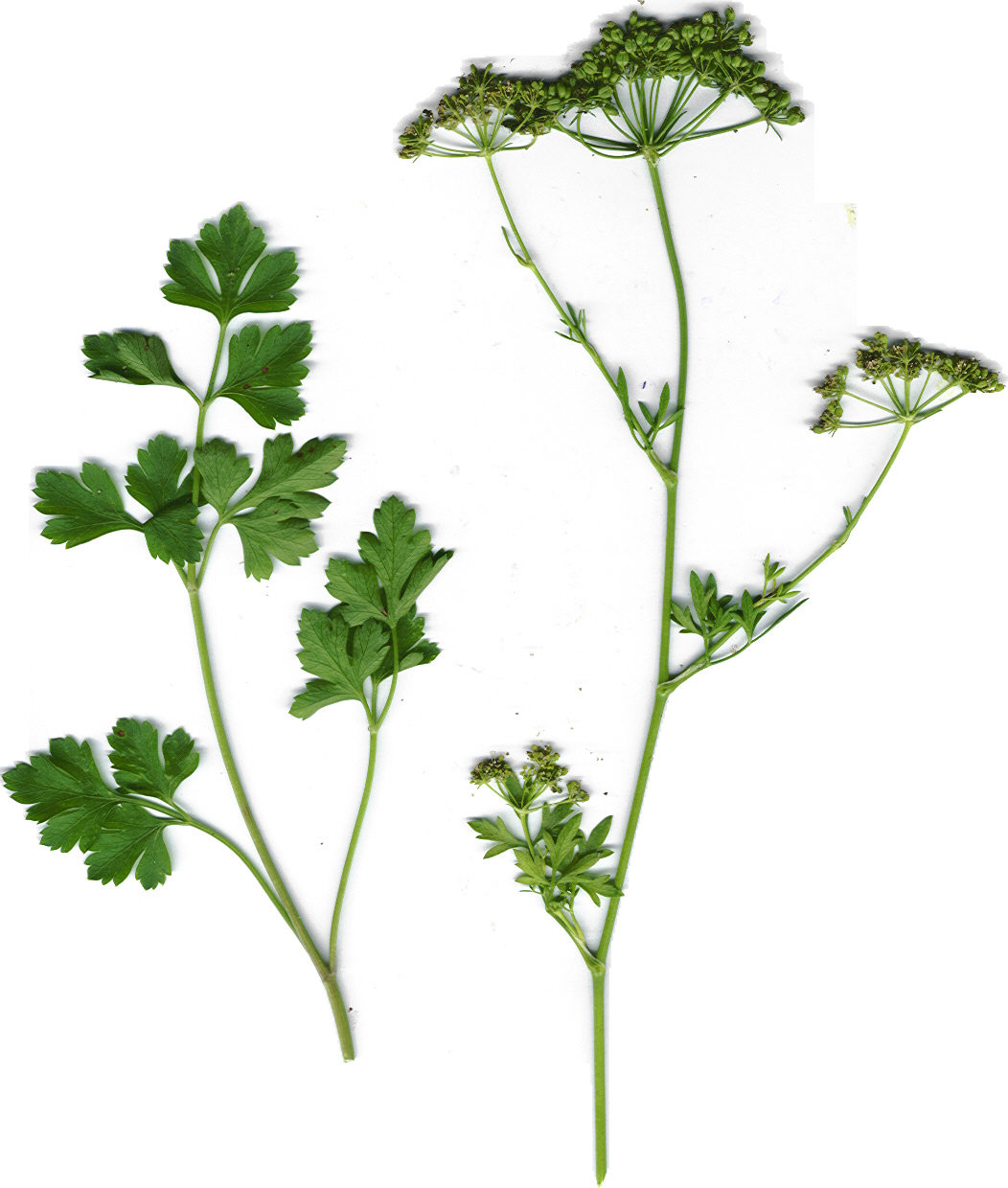
Petroselinum crispum. photo: Forest and Kim Starr

Here’s HerbDoc with the first  of a series of holiday week posts on – you guessed it – herbs!

Here in Rhode Island, the majority of herbs in the garden have been put to bed for the winter, except for the parsley, sage and rosemary which are still green and vibrant.

It’s such a shame that most gardeners think of parsley as a decorative accent and overlook its high medicinal and nutritional value.

In ancient times the Greeks fed it to their horses before a race, believing it would help them to run faster.  They also ate it themselves to subdue the odor of onions and garlic, and men wore parsley wreaths on their heads at banquets thinking that the fumes of wine would be absorbed and that they would not become drunk.

In the Middle Ages, the medicinal uses of parsley were many.  It was used “to cause urine”, assist with liver, stomach and vein problems and “waste away winde.” The name, parsley, comes from the Greek for “stone breaker.” Parsley seed is also one the sources for an organic chemical compound called “apiol” which is used as an essential oil or in purified form for the treatment of menstrual disorders and malaria.  In high doses, apiol is toxic and can cause liver and kidney damage.

Parsley is a very rich source of niacin, vitamin A, calcium, thiamin and riboflavin and has more vitamin C than an orange.  Some herbalists think of it as an excellent arthritis pain remedy, and it is often used to eliminate bad breath.

If you’re interested in having a supply of fresh parsley in the colder months of the year, grow the flat leaved varieties.  Although the curled leaf parsley is the prettier of the two, it tends to hold the cold rain/snow which freezes on the leaves and kills the plants.  I try to grow mine with a little protection (actually under a deck table!) and have almost a year round supply for soups, stews and sauces.

Posted in Uncategorized | Leave a comment

Waiting

Aside from a cursory dusting this week, we remain snowless here in southern Rhode Island. It’s so close to Christmas, and yet, if you explore the woods, it could be November. The trees stand stoically in their duff of fallen leaves, accepting whatever the weather gives them. Without the green of the understory or the leafy canopy, their bark and branches draw my eye. It’s always a pleasure to explore the forest now, without the bugs and the heat and the ticks. Sometimes, secrets are revealed. Other times, I simply appreciate the  “bones” of the trees.

Can you see the old sapsucker holes in this dead birch?

We are so vigilant about raking the leaves in our yards. In the forest, leaves form the “duff” of the forest floor, which in turn nourishes the trees:

In arboriculture, v-shaped crotches are considered bad, because if one side splits off from the trunk, it takes half the tree with it. In the forest, there are no such conventions:

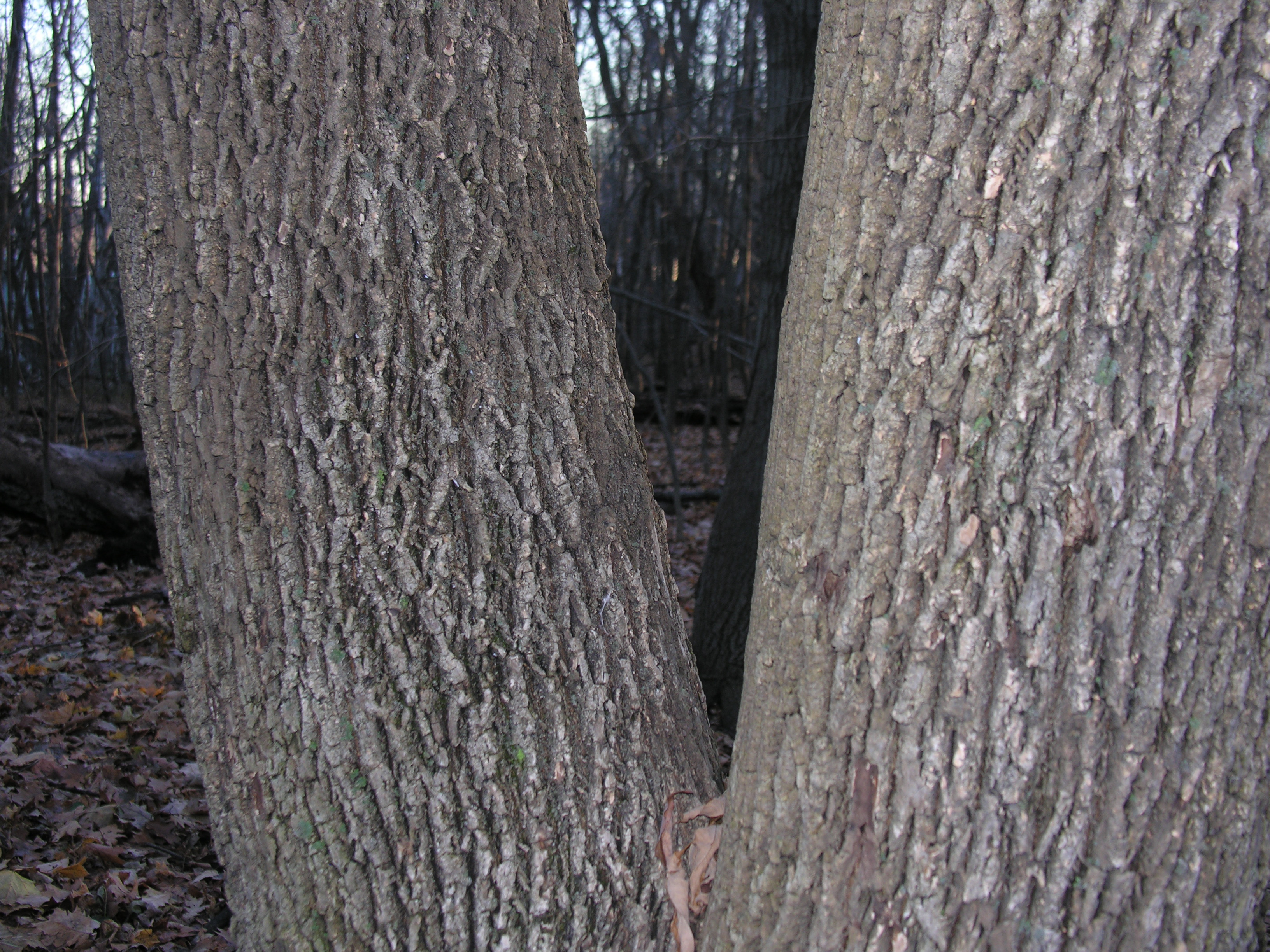
I was drawn closer to this tree because of its deeply grooved and  appealing bark. This is what I saw when I drew closer. When I touched it, it felt surprisingly smooth and warm, despite the cold temperature:

With Christmas nearly upon us, the trees are patiently waiting for their annual blanket of white. So am I.

I wish you,  dear readers, the very best of holidays, and, where geographically appropriate, snow.

Posted in Uncategorized | 5 Comments

Twinkle Twinkle Little Orchid…

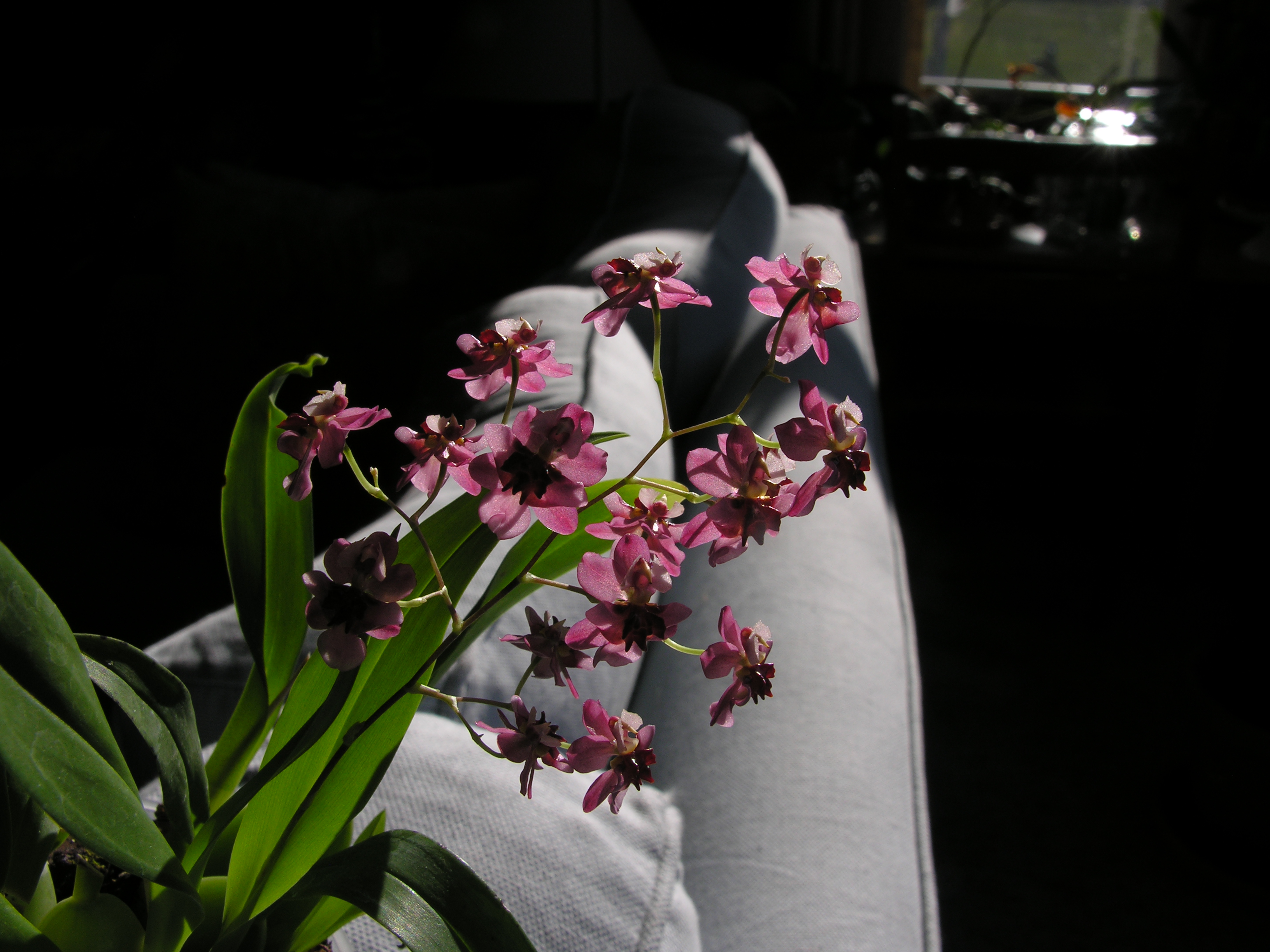
Oncidium Twinkle "Pink Profusion"

The great thing about growing diverse orchid species is that they flower at different times. That means I have something in bloom throughout the year.

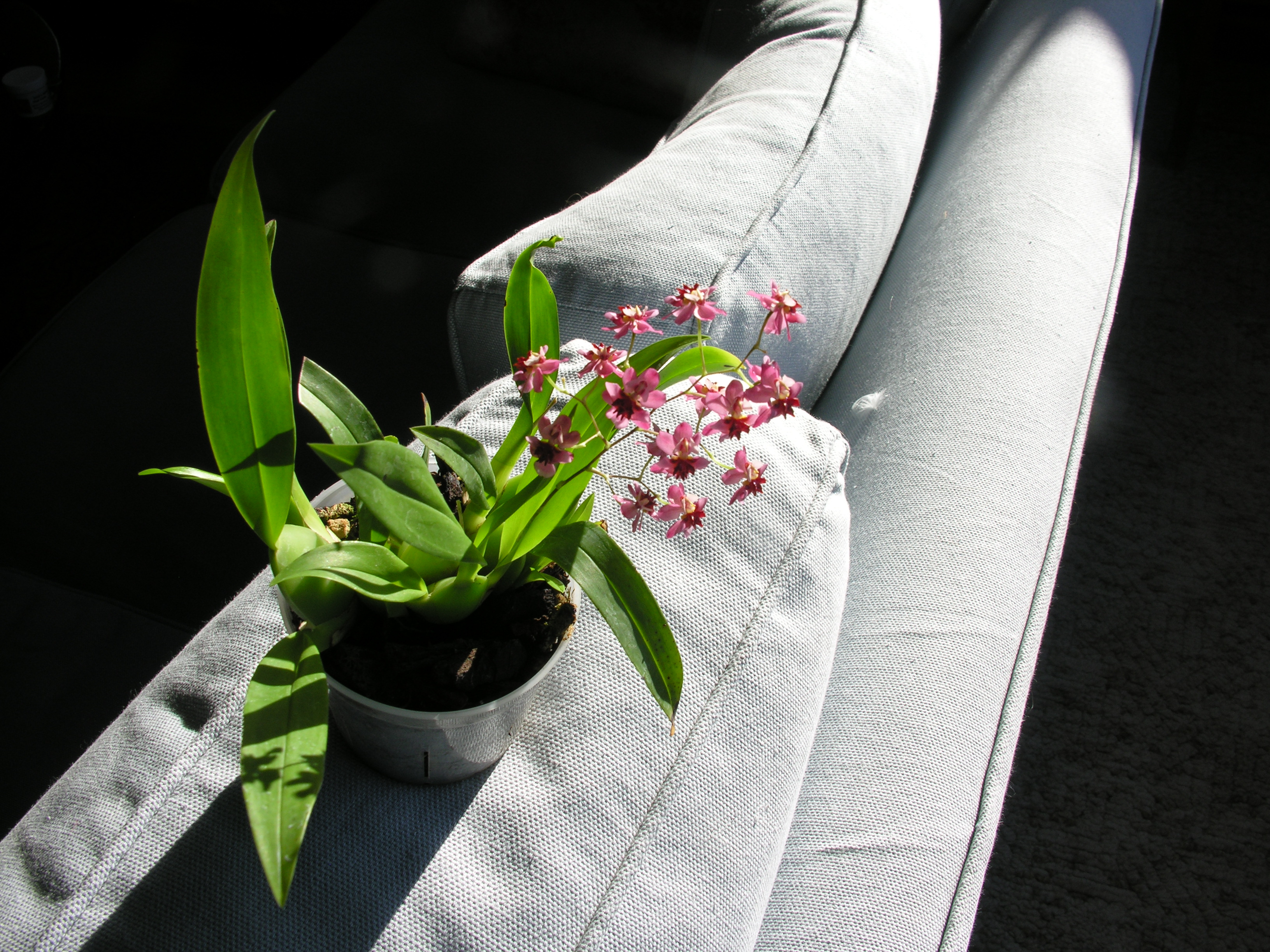
This is Oncidium Twinkle “Pink Profusion.”  I have only had it for about six months, but it seems to be a cheery and undemanding plant. When I bought it, it was in spike, and now it is blooming again, sending up a thin spike with many delicate two toned pink flowers. It is fragrant, too, but I find the scent a bit funky.

The Oncidium alliance is a large one, with over 600 known species. They are native to the American tropics – Central and South America. Everything I have read about mine indicates that it is easy to grow, and I have found that to be true. It sits in a sunny window with its orchid friends, and I alternate its feeding with plain water, Superthrive and Michigan State University orchid fertilizer.

This is a charming little plant with a lot going for it. All in all, great bang for my buck.

Small plant - big impact

Posted in Uncategorized | 2 Comments

Christmas Cactus

Schlumbergera bridgesii. Illustration: UC Cooperative Extension

This seems like an appropriate time of year to consider the Christmas Cactus, Schlumbergera bridgesii. Those of you who own these are seeing them come into bloom right about now. I think they add a flamboyant and tropical touch to the indoor “plantscape.”

This cultivar is actually a hybrid of Sclumbergera truncata and Schlumbergera russiallana, both of which grow as epiphytes in the Brazilian rainforest. S. truncata is sold here as the “Thanksgiving cactus,” and it is easy to confuse the two. The lobes on the leaves of  S. bridgesii are less pronounced, and aside from the different bloom times, that’s about it for visible differences. I have S. truncata, and it is winding down its blooming season now after putting on a commendable show.

Anyway, back to the Christmas variety:

It produces flowers in the usual shades of red, pink and white, and even yellow, which I have yet to see. It likes bright light, cool temperatures, moderate humidity but not too much water, which stands to reason, given that it is a  “cactus” (actually an epiphyte) after all. Once it has finished blooming, it likes a nice month-long rest in a sunny window, and a bit – not to much – water. It likes to be re-potted every two or three years, and you can fertilize it every couple of weeks, once its little rest is over. There are all sorts of “tips” for getting them to come into bloom for Christmas, but I think they usually get the idea as the days get short approaching the winter solstice.

These plants don’t look like much when they aren’t in flower, but for me, that month or so of in-your-face bloom is well worth the wait.

Posted in Uncategorized | 9 Comments

Kalanchoe – My New Favorite Plant

I have been trying to make a happy home for a Kalanchoe (pronounced “collin-co-wee”) for years but without much success…and now I know why. Admittedly, I could have solved the problem by doing a bit of reading but no, I depended on my own gardening knowledge and tried to apply what I knew.  Of course, now that I have a success story to tell I finally did some reading and what I read didn’t totally agree with what I did…go figure.

Here’s what I can tell you about these interesting plants from Madagascar. They are succulents so they need full sun and little water (water thoroughly only when the soil feels dry) and they are great indoor flowering plants, featuring clusters of small flowers that last for months (if you know how to keep them blooming, that is). Commonly available varieties have orange, pink, red, white, or yellow flowers. An important thing to remember is Kalanchoe that have spent their blooms can be kept for their foliage…but why bother since they are neither interesting nor attractive.

Kalanchoe are short-day (actually, long night because plants measure the duration of darkness, not daylight) plants, that is, they begin to make flowers when the days are shorter than 11 hours. From then on it takes about 3-4 months for the flowers to develop. Consequently, they bloom in winter but they are found in stores at other times of the year (I purchased mine in July). Attempting to make these plants reflower the following year is more difficult that bringing back a poinsettia after its summer rest.

Now, here’s how I have managed to keep the plants in bloom for the past four months. My instinct was always to prune off dead flowers by cutting them off with their stems. Wrong. To keep Kalanchoe blooming pinch off only the dead flowers and then keep checking the flower stems. Remove only those stems that start to shrivel, showing no signs of new growth. However, most flower stems will branch and continue to produce flowers month after month. The growth just gets taller and taller and it is amazing and fun to watch this happening in the middle of winter! Kalanchoe is my new favorite plant…this week.

Posted in Uncategorized | 2 Comments