World’s Hottest Pepper

I am the first to admit that I like spicy foods. But I’m also a Rhode Islander, and to me, “spicy” is a jalapeño pepper or two in my homemade salsa. So you can imagine my wonderment when I read this story.

The Naga Viper chilli packs an astonishing 1,359,000 on the Scoville scale, which measures heat by the presence of the chemical compound capsaicin.

If you’re not familiar with the Scoville scale, it’s a system for measuring the heat of hot peppers. It was invented in 1912 by chemist William Scoville. According to wikipedia, the way it works is an alcohol extract of the capsaicin oil from a measured amount of dried pepper is added incrementally to a solution of sugar in water until the “heat” is just detectable by a panel of (usually five) tasters; the degree of dilution gives its measure on the Scoville scale. And by way of comparison, my humble jalapeño measures a measly 2500 on the Scoville scale.

The Naga Viper was not developed by a grower in India, or Thailand, or someplace exotic and tropical, but by a Mr. Gerald Fowler of Cark-in-Cartmel, near Grange-over-Sands, in Cumbria, England (this story just keeps getting weirder and weirder, doesn’t it?). Mr. Fowler crossed the three hottest peppers known to man to create his Naga Viper.

“It numbs your tongue, then burns all the way down. It can last an hour, and you just don’t want to talk to anyone or do anything. But it’s a marvelous endorphin rush. It makes you feel great.”

Yah. Endorphin rush. More like a rush to the hospital…

You can read more about the Naga Viper here.

Posted in Uncategorized | 8 Comments

Pints of Pickled Peppers

I’m almost embarrassed to admit it, but I like this part of the gardening calendar best. Not because it’s time to relax, although of course it is. Not because I get to take stock and plan for next year, although that’s also something I enjoy. No, this is my favorite part of the gardening year because now I get to open and sample some of the stuff I put up earlier in the year. Jars of tomatoes and sweet pickles and dilly beans and jams and jellies beckon…

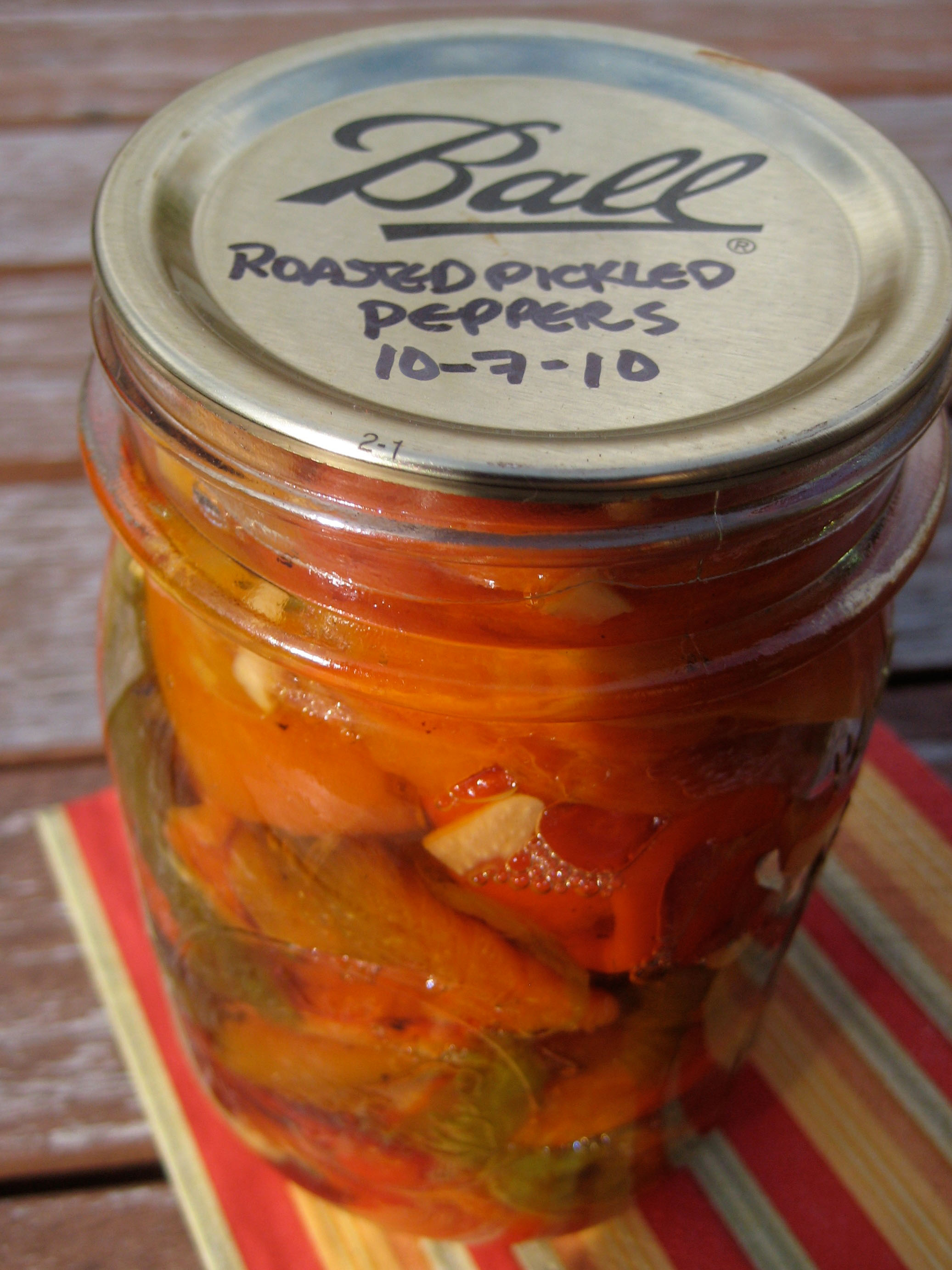
So it was with that same pleasant sense of expectation that I dragged down and opened a jar of roasted pickled peppers yesterday. I’d visited the farmer’s market in Peacedale earlier, and picked up a stick of Fortuna’s excellent “Soupy.” (For non-Rhode Islanders, “Soupy” is the nickname given to soppresata, an Italian dry-cured sausage. Fortuna’s in Charlestown, RI, makes an awesome one.) I was already thinking pizza, with homemade tomato sauce, the soupy, and oh, yeah, maybe some of those pickled peppers I put up this fall.

I no sooner opened the jar than I knew I had something special on my hands. I’d roasted my bumper crop of red sweet peppers on the grill, and got that earthy sweet roasted pepper smell immediately, followed by the mellow notes of garlic and cider vinegar. Mmmm… I have to tell you, they were amazing. I had to stop myself from grabbing a fork and eating the whole jar right then and there.

I got the recipe from Linda Ziedrich’s cookbook, The Joy of Pickling. It’s pretty basic. I think the key is grilling the peppers to roast them.

Pickled Roasted Peppers

1 3/4 cups cider vinegar
1 tablespoon sugar
2 tablespoons pickling salt
1 clove garlic, chopped
3 1/2 lbs. red bell peppers, roasted, peeled, cored, and seeded

In a nonreactive saucepan, bring to a boil the vinegar, sugar, salt, and garlic. Reduce the heat, and simmer the liquid, covered, for 10 minutes.

Pack the peppers into pint or half-pint jars. Pour the hot liquid over the peppers, leaving 1/2 inch headspace. Probe the jars carefully with a wooden skewer or chopstick to release all the air bubbles. Close the jars with hot two-piece caps, and process the jars for 10 minutes in a boiling-water bath.

Store the cooled jars in a cool, dry, dark place for at least 3 weeks before eating the peppers.

Makes 2 1/2 pints

Posted in Uncategorized | Leave a comment

Beware the Montreal Squirrels!

Evil personified

Another dispatch from my former home city of Montreal: This one has to do with the city’s squirrels, which are apparently harassing park visitors.

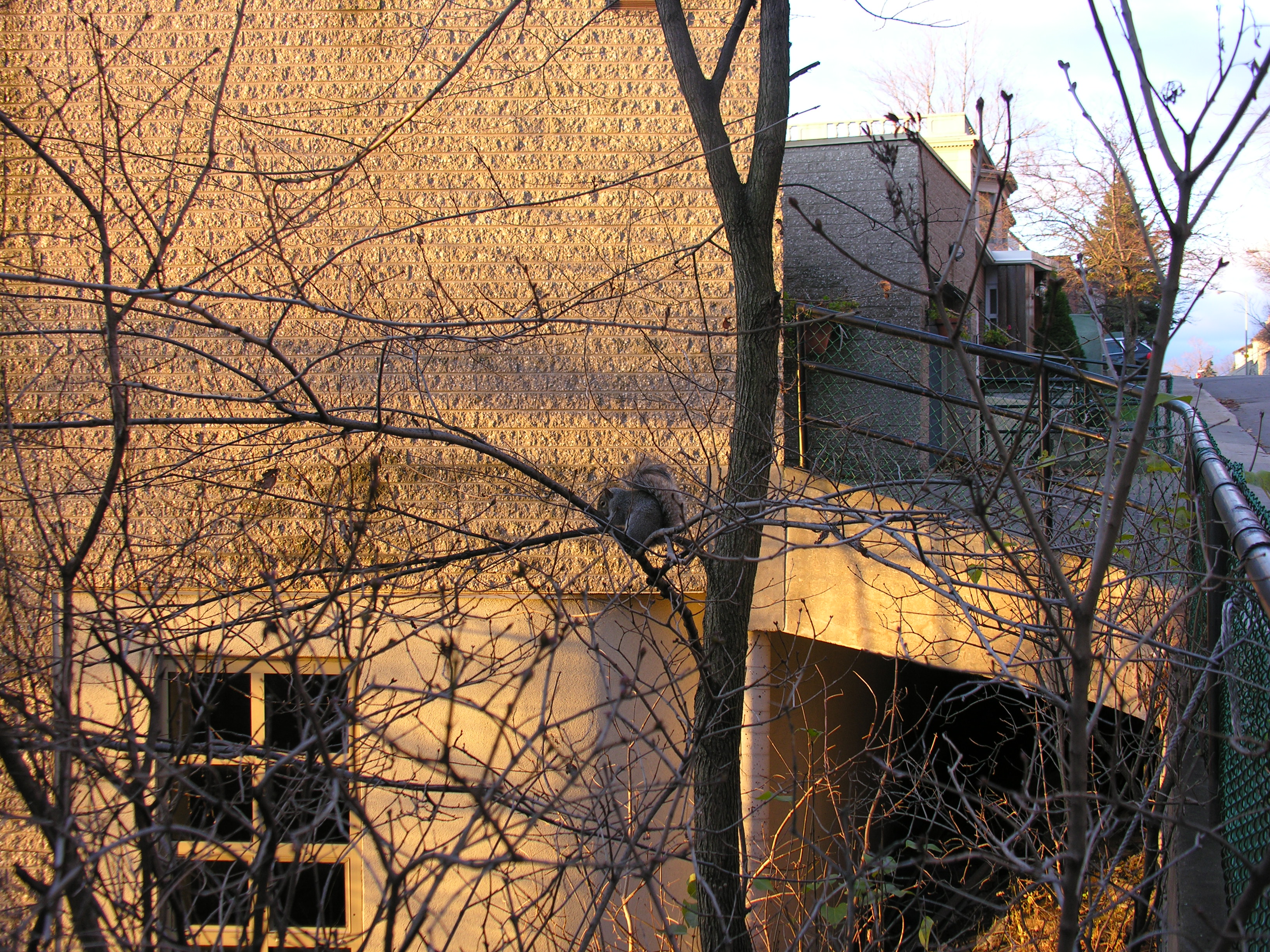
News reports tell of squirrels stalking people and even leaping into baby strollers and snatching food from toddlers’ hands! Of course, this is the season when squirrels, which do not have the luxury of hibernation, must fatten up in preparation for Montreal’s brutal winter. In places where people feed them, they rely largely on handouts, as well as whatever they can get from the trash bins.

Some municipalities such as Westmount have passed laws prohibiting the feeding of all wildlife. One man was fined more than $400 for feeding a squirrel in one of the city’s parks!

Just waiting to strike!

Deep down in our hearts, we all know that feeding squirrels only makes them dependent on us for handouts, and that the more humans feed them, the bolder they become. Needless to say, I remained a mere observer on my recent visit. Those fines were enough to deter me!

Posted in Uncategorized | 8 Comments

The Ultimate Urban Dog Park

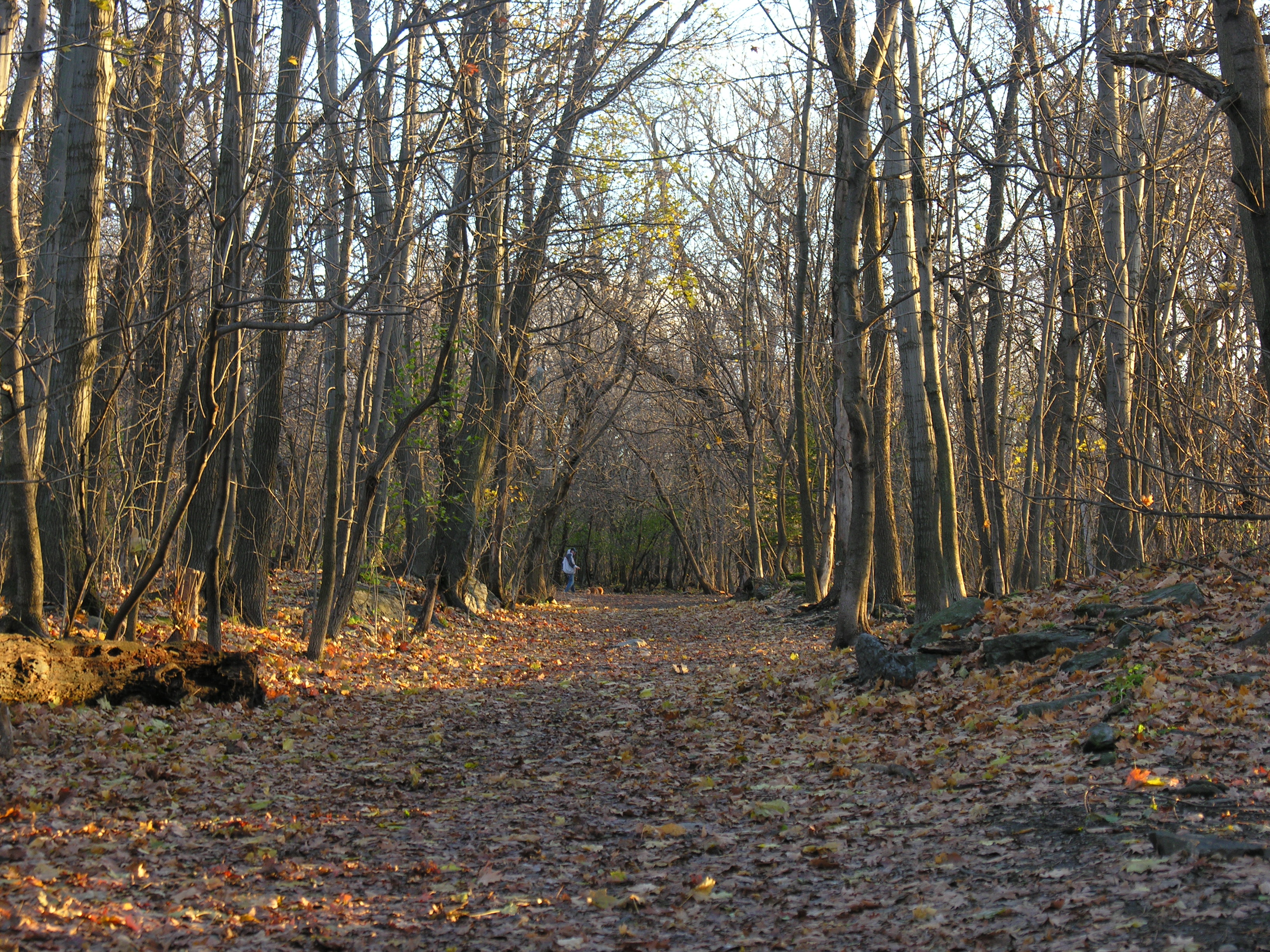
As I explained in my last post, I was in Montreal for several days recently. One of the nicest things about my former city is Summit Park in Westmount. Sitting at the very top of the mountain, this wooded area has been left largely untouched, except for the paths that wander through the woods. The great thing about those paths is that they are open not only to people, but to dogs.

Summit Park, seen from the road

I walked up to the park early one morning to catch the action. Dogs are allowed all day, but they are free to run off leash before 9 am and after 6 pm. Yes!

Many people walk their dogs here before and after work. It gives the dogs a chance to blow off steam, and the owners enjoy the wooded paths – even in the weak watery light of November.

Fun, fun fun!

Dog waste receptacles and even bags are thoughtfully provided. The fine for not picking up after your dog is stiff: $300. I did not encounter any dog waste, so the incentives –  and deterrents- must be effective.

I will leave you with the famous shrine, St. Joseph’s Oratory, which looms beyond the trees on the north side of the park.

The Oratory

Posted in Uncategorized | 6 Comments

Gift-wrapped Greenery

I was in back in Montreal recently, visiting relatives and friends. In November, people start wrapping their trees and shrubs to protect them from the road salt and the cold. Some Montrealers (my good friend among them) scoff at such measures. I have to admit, growing a shrub like boxwood there is quite a stretch. Perhaps people should stick with plants that can take the harsh winter conditions.

I wrote about this when I was there last year, but I couldn’t resist taking some new photos this time.  So, for your viewing pleasure (and amusement) here is more gift -wrapped greenery:

The ghosts of winter

More ghosts

I was walking my friend’s dog, and he was afraid of these. Maybe he’s onto something…..

A row of arborvitae, fenced, then wrapped

Your boxwood is protected, Madame

This rose is seriously undercover

Finally, no winter protection is complete without coir – or in this case rubber – to cover the slippery stairs.

Custom rubber stair mats. Nice!

I think people should try to plant shrubs that can survive the winter without elaborate protection. However, having lived for so long in Rhode Island, I have forgotten what those plants are in Montreal.  I do like the rubber mats,  especially the way they’re cut to fit the contours of the stairs.

I think the “ghost shrubs” are silly, though.

Posted in Uncategorized | 8 Comments

Thanksgiving and Sage

salvia officinalis

HerbDoc has some musings on one of our favorite herbs, and one we use often during the holidays:

Thanksgiving is a few short days away, and one of the herbs that no cook can be without is sage.  Sage has a long history as an herbal medicine and as a culinary ingredient.

It was once said that sage cured tuberculosis and effectively treated snakebite, and many still see its value in reducing headaches and sore throats and as a digestive aid.  Its very name, “Salvia,” means health or salvation.

Sage is a very hardy perennial which is still a pebbly gray-green in my garden, and it will probably stay that way for the remainder of the winter. Since it becomes very woody and tough with age, its woody growth should be cut back in March.  I also try to replace my plants with new starts or cuttings every three to four years to prevent the toughness that comes with old age.  The best time to harvest sage is no later than September, and the most useful leaves come from the tops of the plants.

This herb is used extensively in stuffing and sausage, and the best one to grow for this purpose is Salvia officinalis which has a hint of lemon.  Other sages may be too strong and overpowering, and my beloved Pineapple Sage actually loses its scent/taste when dried. Be aware that if you’re a purist, the small boxes of turkey seasoning and bottles of dried sage on the grocer’s shelves probably contain several varieties of sage.  If using these it might be a good idea to add a healthy dose of dried parsley to the mix as it is said to cut the overpowering taste of mixed sages.

Sage also has a long history in the practices and folklore of the ancients.  In the past, sage leaves were strewn on graves as a sign of remembrance, and it was also said that if a young girl picked twelve leaves of sage at midnight on Christmas Eve and put them under her pillow that she would see the face of her future husband in her dreams.

We at Digging RI would like to wish all our readers and friends a very happy Thanksgiving. We are so thankful for your input and support!

Posted in Uncategorized | 5 Comments

My Masdevallia

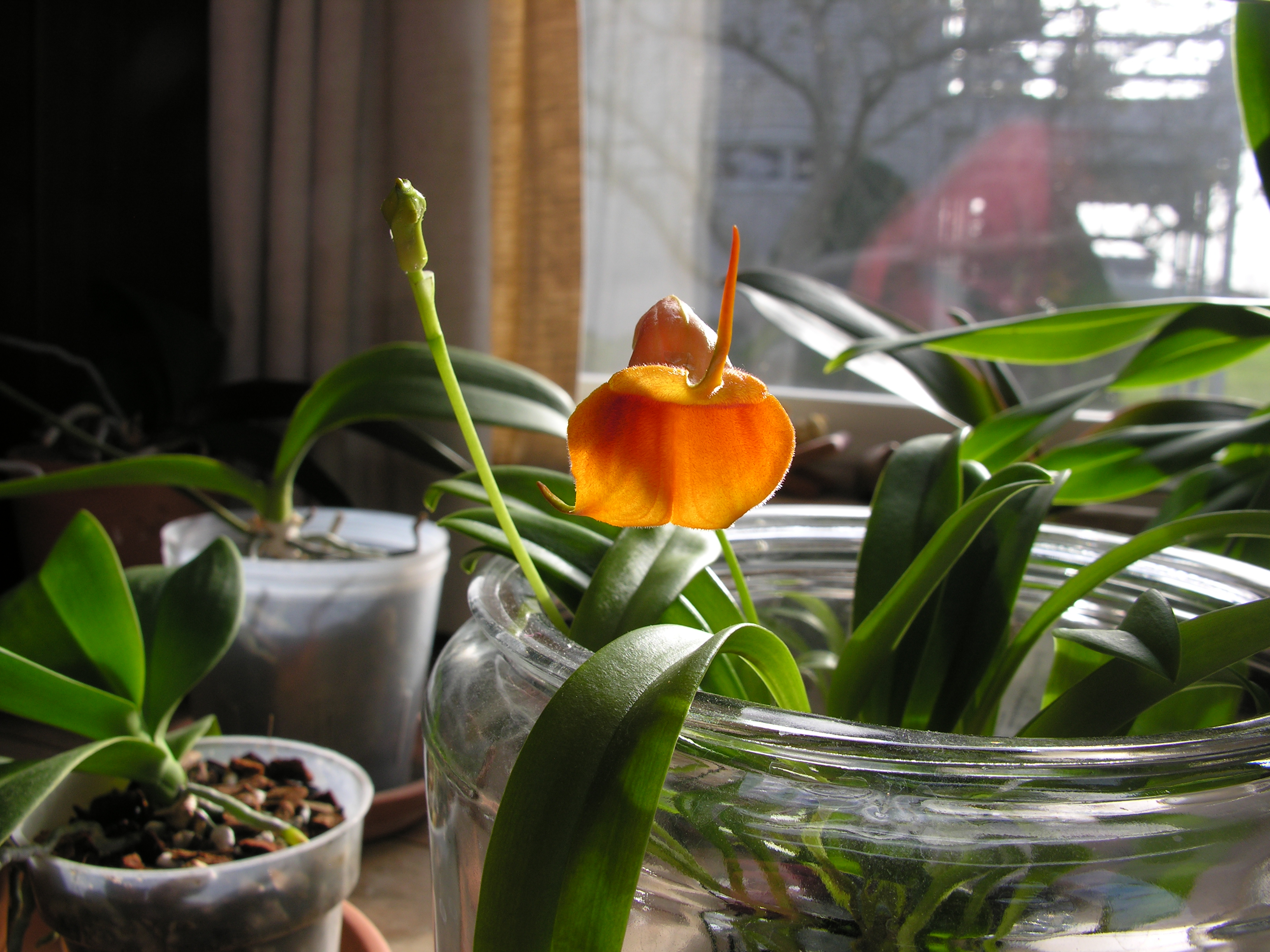
Masdevallia "Gold Dust" in its open glass jar

It’s the little things that make me happy – like buying an orchid that is reputed to be difficult to grow, and getting it to bloom often. Since I entered the orchid world a few years ago, I have been trying to learn as much as I can about these enigmatic and fascinating plants. I have also been growing  more obscure cultivars, because it is so  challenging and rewarding.

Masdevallias (pronounced mas-de-VAL-ee-ahs) are members of the Pleurothallid alliance. They are native to the cloud forests of Peru, Colombia and Ecuador. That means they grow at higher elevations, in humid but circulating air and relatively cool temperatures. I knew about the temperature thing when I first read up on mine, (Masdevallia “Gold Dust”) so I was not surprised when it blew its emerging flower buds during the oppressive heat of last summer.

So the challenge for me was to try to replicate this plant’s natural habitat, without the luxury of a greenhouse. Masdevallias do not have pseudobulbs, which means they cannot store water, which in turn means they must be kept consistently moist, but cannot stand in water either. I set my plant on a bed of pebbles, inside a large, open glass jar. That way, I figured it would stay humid down by the roots, but the air would still move freely. It sits in a southeast corner window with most of my other orchids, and gets lots of light.

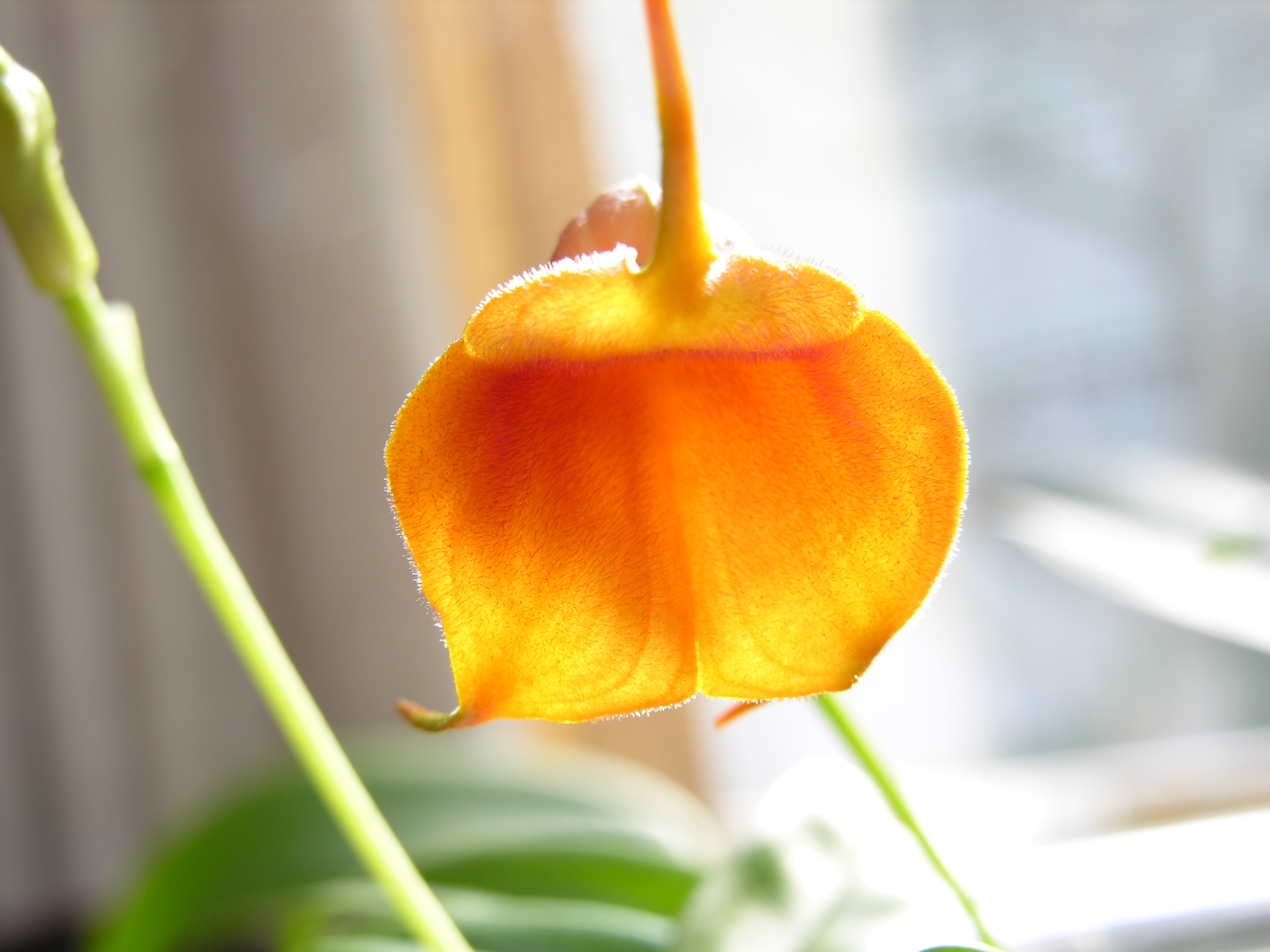
My plant was just under a year old when I bought it, and in a few months, I was seeing spikes emerging from the bases of the leaves. I have read that they flower at certain times of the year, but mine seems to flower whenever the spirit moves it. It’s the sepals that provide the color. The sepals of “Gold Dust” are a deep gold, but if you look closely, inside there’s a subtle, slightly fuzzy wash of lavender. I couldn’t capture that with my camera, so you will just have to believe me.

My Masdevallia has almost doubled in size since I got it, but it will never be a large orchid. I love its quirky growing habits, and the intense color of the blooms. As I said, it’s the little things….

Posted in Uncategorized | 8 Comments

Winter Weather Predictions: Take Your Pick

As a gardener, and someone who enjoys outdoor activities such as  skiing, I would like to have a general idea of how the coming winter is going to be. I know it’s impossible to know exactly, but you’d think that between the old time knowledge and “cutting edge” science  there would be some kind of consensus.

Au contraire. Here’s an overview of this year’s winter weather predictions:

Wooly bear caterpillars: The wider the brown band is, the more severe the coming winter will be. I did not see more than a couple of these caterpillars this year, so I don’t know what they’re predicting. Of course, scientists discount this as hogwash, but are they any better with their forecasts? Let’s see, shall we?

Mast: This is supposedly a mast year for oak trees, which means they produce several times more acorns than usual. I’m not so sure. The oaks around here (RI) don’t seem to be producing more acorns this year. Anyway, no one really knows if mast is even significant in helping predict winter weather. One professor – a Ph.D. –  describes it as “a mystery.”

Climate variations: Then there’s La Nina, the opposite of El Nino. This is supposed to be a strong La Nina year, which means more precipitation in the northwest, dry conditions in the southern and Midwest states, and for the northeast? Well, it could be colder and snowier, or it could be “average” depending on who you listen to. Here’s a link to NOAA’s El Nino/La Nina page. I guarantee you’ll be even more confused after reading it!

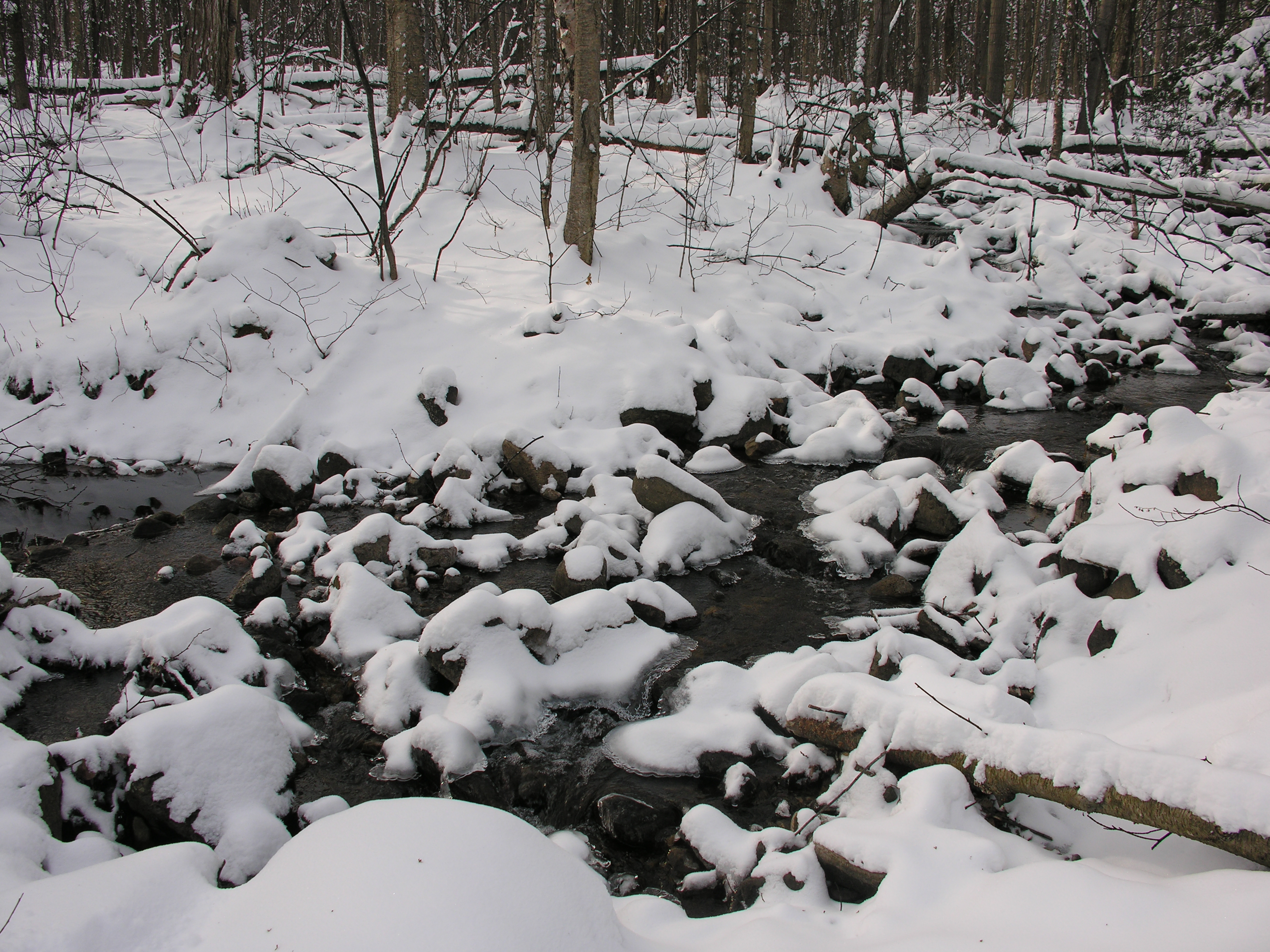
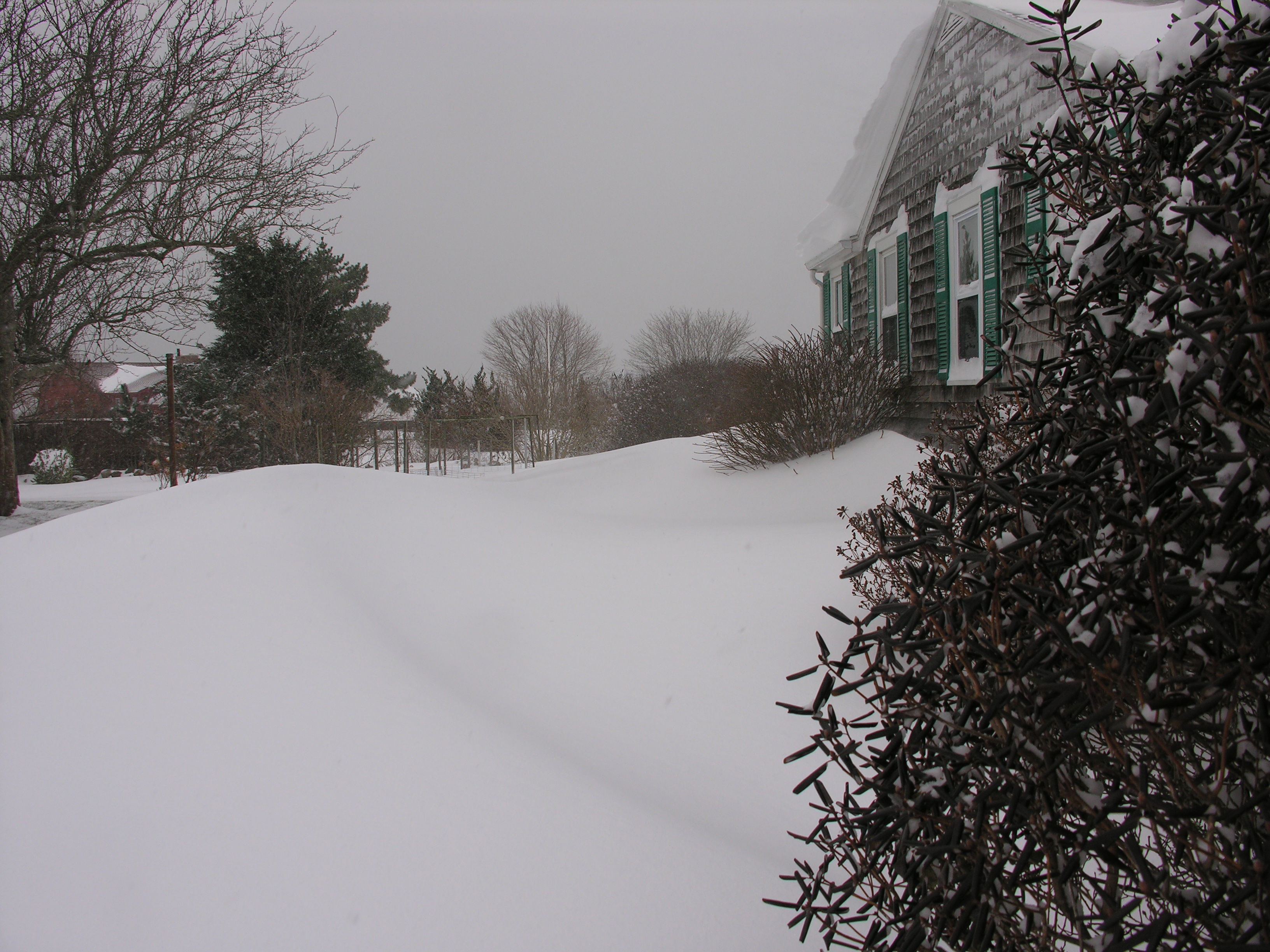
Storm aftermath, December, 2009


It’s extraordinary how even the most scientific forecasts can vary, depending on the different computer models, and how the data are interpreted. I suppose I will just go about my usual winter preparations and hope for the best. It would be nice to have  a little more snow this year, though…..it makes such a cozy blanket for the garden and it’s really fun to play in.

Killington, Vermont, 2010


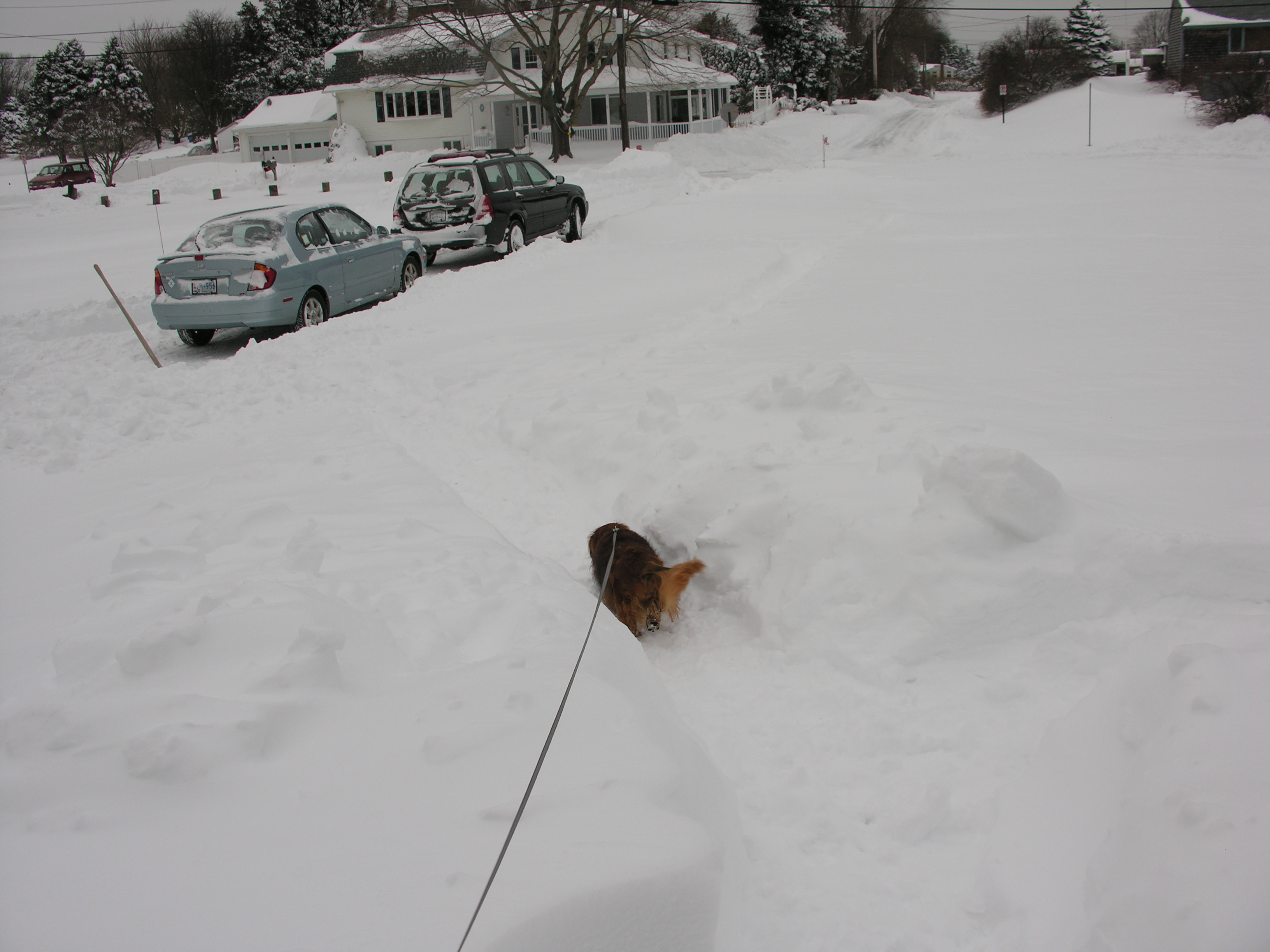
Finally, the most accurate gauge of winter weather (but not a good predictor) is my dachshund. If she disappears in the snow when she goes out, there’s a lot of it.

My "Weather Wiener"


Posted in Uncategorized | 5 Comments

A Great Read for Gardeners: The Sound of a Wild Snail Eating

I don’t remember how I came across Elisabeth Tova Bailey’s book, “The Sound of a Wild Snail Eating” (Algonquin Books, 2010). I downloaded it on Kindle, and was so quickly drawn in that I could not put it down until sadly, I had finished it.

This true story is both straightforward and complex. It is about a woman who, while on holiday in Italy, is stricken with a mysterious disease. She returns to the United States, and becomes increasingly debilitated to the point where she is bedridden and looked after by a caregiver in what she calls a “white room,” away from her beloved home, her dog and her garden. Day after day, she lies in bed, unable to perform the simplest of tasks. As her universe becomes smaller, her mind remains as active as ever, and her attention to detail is heightened and focused.

One day, a visitor brings her some wild violets in a pot. In the pot is a small snail.

Bailey writes: “Those field violets in the pot at my bedside were fresh and full of life, unlike the usual cut flowers brought by friends. Those lasted just a few days, leaving murky, odoriferous vase water. In my twenties, I had earned my living as a gardener, so I was glad to have this bit of garden right by my bed.  I could even water the violets with my drinking glass. But what about this snail?” *

The snail initially intrigues, then fascinates, and, for a while, consumes her. Bailey makes it her mission to research woodland snails, learning more about their diets and their lives in the wild. Suddenly, she is DOING something,  and her days acquire a sense of purpose.  In her world, when even turning over in bed is an arduous undertaking, she spends most of her time observing the snail, first in the pot of violets, then in a terrarium that she keeps by her bed. She is amazed and captivated by its daily routines – what it eats, how it gets around, where it sleeps.

“ Whereas the energy of my human visitors wore me out, the snail inspired me. Its curiosity and grace pulled me further into its peaceful and solitary world. Watching it go about its life in the small ecosystem of the terrarium put me at ease.”

Bailey eventually recovers to the point where she can return home. She still isn’t strong enough to work in her gardens, but she spends hours sitting outside with her dog, enjoying them with a new appreciation.

“My gardens were awakening, and whenever possible I was outside on a chaise longue with Brandy at my side. We watched the sunlight find its way through the branches of the crabapple tree, dappling the blue squill and crocus, and we looked for the pointed noses of tulip leaves as they emerged in the perennial beds. Each week more perennials came into bloom, and the hedge that bordered the garden began to fill with nesting birds”…”I could close my eyes and feel the sun warm my whole length and the wind ruffle its way over me. My ears filled with the dozy hum of bees and those tiny and odd insect sounds that rise up all around, the sounds mingling in my mind with the good, deep smell of earthy life.”

This is a book which, for those of us who are close to the land, provides a new perspective on the flora and fauna that live there – especially the intricate world of the tiny and often overlooked creatures that inhabit our world and our gardens. It is also a powerful and moving account of how an active life can be suddenly and drastically changed.

*Excerpts used with permission from the author and Algonquin books.
Posted in Uncategorized | 2 Comments

Salvia in the Snow

Verbena bonariensis in the foreground. Another toughie!


I love growing this red salvia because it attracts hummingbirds like a magnet. It’s been sitting outside in its container on the deck, because I like to collect the seeds for next year, and it also seeds itself in situ rather nicely.

This morning, I awoke to snow on the ground, the result of a nasty storm which is now pummeling us with wind and rain. I looked outside as I was having my coffee, and there, being buffeted to and fro, was the salvia, red as ever, defiant in the face of winter!

I know it’s only a matter of time before it succumbs, but not today. This is one tough little plant.

Posted in Uncategorized | 6 Comments