If you woke up today and discovered that the leaves on some of your garden plants were half eaten…and felt like crying when you spotted skeletonized leaves on the roses…you have probably been infested with sawfly larvae, and you are not alone. Yes, it is early May and they hatched, exploding in numbers, and may be seen on many plants in your garden.
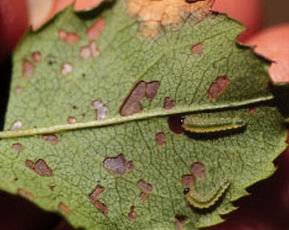
Two rose sawflies on the underside of a rose leaf.
There are many species of sawflies, three of which feed on rose foliage and these are the ones that I worry about the most. Like most species of sawflies, they are green and small (maybe one-half inch long) and look like inch worms. Since they feed on the underside of leaves that is where to look for them.
Fortunately, if you find the little critters early enough, control is possible and damage can be minimized. Also, remember to be vigilant through June when they finally stop feeding.
Several options exist for control of sawflies. One method is to simply pick them off by hand or use a stick or a stream of water to dislodge them. If you use using water spray early in the day so foliage dries by sunset which avoids favorable conditions for fungal development. Horticultural oil, insecticidal soap and neem are low-toxicity insecticides for young sawflies. But we never have the luck to find the young ones, so a conventional insecticide is the better choice. Common insectides that are readily available are Orthene, Sevin, malathion, and diazinon. It is most important to avoid spraying the rose flowers because most conventional insecticides are highly toxic to bees.









 Digging RI