A Fish for Whom He Loves

When I went for my morning walk today I was thinking about how I missed all the birds and then I heard the “chewk-chewk-chewk” of an osprey. I looked up and there were two birds circling overhead so I looked down at the osprey platform and to my great surprise a fledgling was there, waiting for food! What a treat!

If you are an osprey lover like I am then go over to Matunuck, RI next summer. There, standing in the wetlands, is an osprey platform. Ospreys began to nest thereonly a few years ago, which is undoubtedly attributable to the fact that ospreys have bounced back from about 55 nests around coastal RI in 2000 to 104 nests in 2008. In fact, ospreys have been taken off the endangered list and are now regarded only as threatened.

The osprey family that lives in Matunuck produces one brood, usually with two chicks, each year. Family ties are strong, which is rather necessary considering that Ospreys`on a breeding platform.incubation takes two to six weeks and the hatchlings remain in the nest for seven to eight weeks. So, for as much as 14 weeks…that’s more than three months…the family stays together. This is nirvana for osprey watchers because they are there all summer.
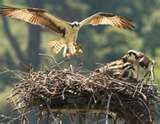
John James Audubon wrote this about ospreys: “During the incubation period the male bird is now and then observed rising to an immense height in the air, over the spot where his mate is seated. When [he] has attained [his] utmost elevation, which is sometimes such that the eye can no longer perceive him, he utters a loud shriek, and dives smoothly on half-extended wings towards his nest. But before he reaches it, he is seen to expand his wings and tail, and in this manner he glides towards his beloved female, in a beautifully curved line. The female partially raises herself from her eggs, emits a low cry, resumes her former posture, and her delighted partner flies off to the sea, to seek a favourite fish for her whom he loves.”

What a magnificent bird!

Posted in Uncategorized | Tagged | 5 Comments

Saving Seeds

seeds2

Here’s a timely post from our friend and gardener extrordinaire, HerbDoc.

This is the time of year that I begin to think about saving seeds for next year. It’s one way to save a little bit of money and promote sustainability and biodiversity at the same time.

If you’d like to try saving seeds, make sure that only heirlooms or open pollinated varieties are saved.  Hybrids will not breed true, and the plants produced may look very different from what you are currently growing.

Since I’m only growing heirloom tomatoes this year (Mortgage Lifter, Silvery Fir Tree and Brandywine), I will allow a few of each to become slightly overripe on the vine. Then the contents can be scooped out and placed in a bowl of water.  Tomatoes have a germination inhibitor in the gel that surrounds the seeds

tomato seeds with seed coats

tomato seeds with seed coats

so that must be removed.  After a few days in water, the pulp and gel separate from the seed.  The seeds, which will fall to the bottom, can be removed and dried on paper towels.  Store them in labeled glass jars or pill containers in a cool, dry place.  Sometimes I’ll put a little packet of silica gel from my vitamin bottles in the bottom to stop moisture from forming.  Eggplant and peppers can be done the same way.

Zucchini can be left on the vine until it hardens so the seed will be very large and well-developed.  Slice the zucchini open lengthwise and pick out the seeds.  There’s no need to soak them, but do dry them on paper towels before storing.  Cukes, on the other hand, will have to go into a bowl of water to break down the pulp before you can harvest the seeds at the bottom of the bowl.  Beans are the easiest of all the vegetables to harvest; just let them dry on the vines and remove them from the pods!

If done correctly and kept cool and dry, you’ll have a bumper crop of little seedlings next year at no cost!

Posted in Uncategorized | 2 Comments

First Bees, Now Bats

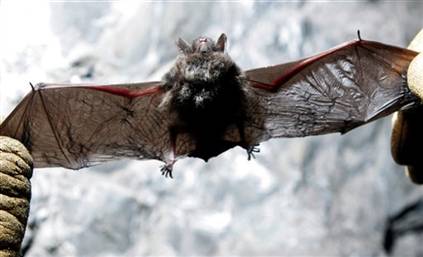
Dead Bat, AP photo

Dead bat (AP photo)

Have you noticed fewer – or  no – bats in your area this summer?  I’ve been hearing and reading a lot about bats lately, and the news is horrendous. Bats by the hundreds of thousands are being wiped out by something called “white nose fungus,” so named because it appears as fuzzy white patches on the bats’ faces and skins.

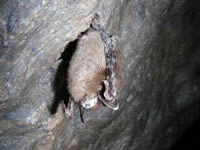
These Geomyces fungi  live in cold places, and attack bats in the caves where they gather to hibernate in the winter. Scientists still don’t know if the fungus is solely responsible for killing the bats, or if environmental factors are contributing to the problem, but they have found that infected bats wake up more often, burning up their fat reserves and starving to death.

little brown bat with fungus

Little brown bat with fungus

It seems the fungus was first noticed in a cave in upstate New York. It has now spread as far as Indiana, and biologists are warning that it could soon infect bats nationwide, including some endangered populations.

Testifying before two Congressional subcommittees last June, experts said that so far between 500,000 and 1 million bats have died, but that this could be just the beginning of an ecological disaster, and what they called “the most serious threat to wildlife in a century.”

Like most gardeners, I know that bats are vital to the ecosystem. Between April and October, they eat their body weight in insects every night.  So, the loss of 500,000 bats means that 2.4 million pounds of bugs are not being eaten!  Bats in other parts of the country are important pollinators, too.

In an effort to keep the fungus from spreading further, the National Forest Service closed  caves this summer from Minnesota to Maine. Other caves and mines across the country will be closed as well. This might not be the answer to stopping the fungus, but officials are worried that cavers might be spreading it unintentionally. In the meantime, scientists are working on understanding the fungus and finding a way to stop it.

an infected bat at the Greeley Mine, Vermont

An infected bat at the Greeley Mine, Vermont

Of course, this research effort costs money. Estimates put the cost at about $11 million, and so far, the Senate Appropriations Committee has allocated a paltry $500,000. I don’t know about you, but I think this is tragic…just tragic.

Posted in Uncategorized | Leave a comment

A Bridge in Bloom

With the summer gardening season winding down, we have a pleasant hiatus where we can enjoy our own gardens and sneak away to see other horticulturally interesting places.

My husband and I discovered one of them quite by chance. We turned off Route 2 at the town of Shelburne Falls, MA on the Mohawk Trail, lured by a sign that promised glacial potholes.We saw the potholes, which are interesting, and took a stroll through the town, not realizing that we would run smack into The Bridge of Flowers.

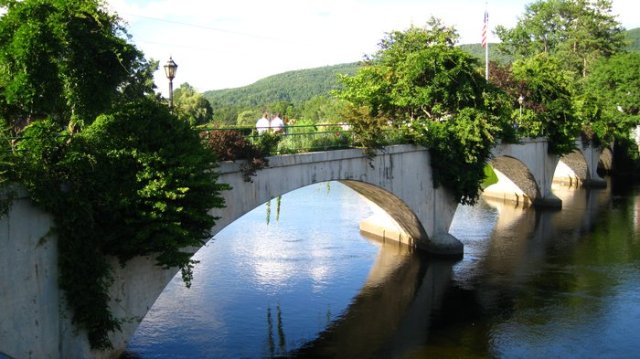
The Bridge of Flowers

The Bridge of Flowers

The idea of having a bridge entirely devoted to flowers may sound hokey – until you see it. It’s a 400 foot span of non-stop flower and plant action, and it’s blooming from the beginning of April right through to October.

The Bridge of Flowers is a defunct trolley bridge that was turned into a tourist attraction in 1929. Volunteers from the Shelburne Falls Area Women’s Club Bridge of Flowers Committee have been maintaining this site for 80 years. There is also one full-time gardener.

Visitors enjoying the Bridge last May

Visitors enjoying the Bridge last May

More than 20,000 people visit the Bridge every year. It’s gratifying to see how the simple act of caring for plants can transform a derelict structure into a thing of beauty and a successful tourist attraction that benefits the entire region.

Posted in Uncategorized | 4 Comments

A Beneficial Insect

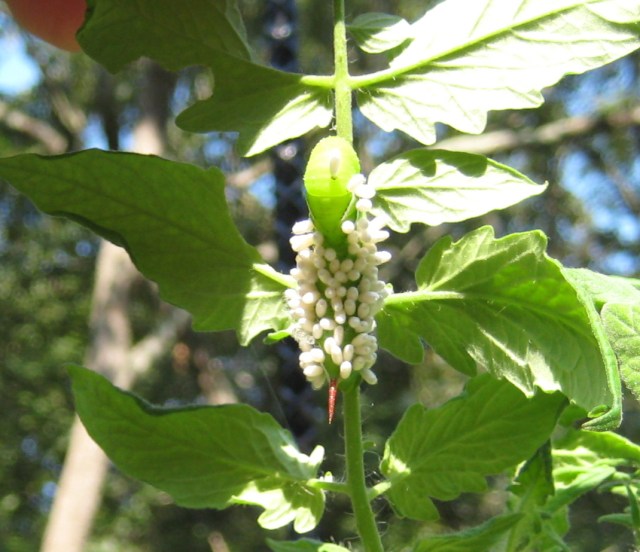
Brachonid wasp coccoons on a tomato hornworm

Brachonid wasp cocoons on a tomato hornworm

Here’s another interesting post from our friend, HerbDoc:

One of my first memories of vegetable gardening at my grandparents’ home involved being given a half pound Chock Full O’Nuts can with which to pick the ugly green tomato hornworm.  These were often fed to the chickens once picked.

Over the years I followed the routine of picking and discarding these pests when I found them, but lately have become very interested in beneficial predators.  Enter the tiny brachonid wasp.  This small insect is very dark, sometimes with tinges of red and has transparent wings.  The females have a very long ovipositor with which to lay eggs under the skin of the tomato hornworm.  The eggs hatch and the larvae eat the hornworm from the inside out.  Once they emerge they spin tiny white cocoons that look like eggs; after a couple of weeks the adult brachonids emerge through an opening in the tip and begin the process all over again.  I carefully watched one particular hornworm as it literally turned from fat and green into a black, desiccated stick!  Using my loupe, I could make out the head and what was left of the body segments.

Note to gardeners:  if you see those nasty tomato hornworms with what looks like white eggs on their backs, leave them there.  They are carrying around a very significant biological control that will not only destroy them but also their descendants….and we don’t have to go through the tedious process of picking them off the tomato plants!

What's left of the hornworm - little more than a stick!

What's left of the hornworm - little more than a stick!

Posted in Uncategorized | 6 Comments

Christmas in August

DSCN5083

Every year, the University of Rhode Island Master Gardeners grow pointsettias. They sell them in December, and the proceeds help fund their programs. The growers ship them free plugs, in return for which they carefully monitor each cultivar and supply the growers with detailed reports once the sale is over. It’s a plant trial, and an educational experience that most Master Gardeners enjoy. Many of the 65 varieties they grow are quite unusual and exotic.

Plants are measured weekly

Plants are measured weekly

Crews have been tending the “points” for several weeks already, and it is a bit strange to be  growing something so Christmasy in the summer. Even the names of the cultivars are wintry: “Polar Bear” and “Jingle.” Armed with light clothing and lots of drinking water, groups of Master Gardeners go to the greenhouse seven days a week. They water, they fluff the soil, they fertilize, they give calcium, they check for pests, they measure and document how each cultivar is growing – in other words they coddle the heck out of them until early December, when the crowds finally come to take them away.

The plants were pinched a few weeks ago – a necessary step unless you want just one scrawny colored bract per plant. They are nice and bushy now, and the parasitic wasps are working tirelessly (and selflessly) to control the fungus gnats.  I’ll file another dispatch from the greenhouse when they’re a little farther along. In the meantime, the photo below shows how they looked last year, just before the big sale.

Festive aren't they?

Festive, aren't they?

Posted in Uncategorized | 4 Comments

Restoring the “Redwoods of the East”

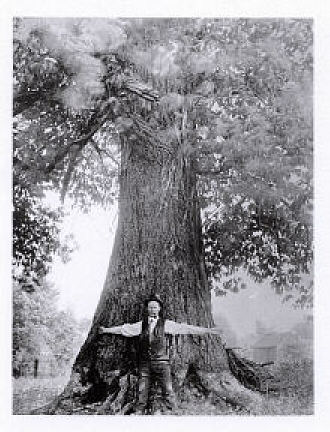
American Chestnuts were very big trees!

American Chestnuts were very big trees!

Last weekend, I finally had a chance to visit a new and very exciting project. The University of Rhode Island Master Gardeners are managing an American Chestnut tree research orchard. This is the fourth such orchard in the state, part of the American Chestnut Foundation’s restoration project.

The sad story – and cautionary tale –  of the demise of Castanea dentata began in 1904, with the introduction of blight from China. By 1940, 4 billion – yes, billion! – trees had been wiped out throughout eastern North America, leaving only scattered sprouts and a very few mature trees. American Chestnut trees were tremendously important to the ecosystem because of their dependable annual production of nutritious nuts and their valuable timber. The disappearance of the trees was a source of considerable hardship to the human and animal populations that depended on them.

In research plantations throughout the trees’ original range, the American Chestnut Foundation is developing blight-resistant seedlings.

An F1 hybrid

An F1 hybrid

By backcrossing and incrossing American Chestnuts and blight- resistant Chinese chestnuts, and inoculating seedlings with blight and selecting the hardiest survivors, the Foundation hopes to eventually come up with a hybrid with the  resistance of the Chinese and the stature of the American.

The URI Master Gardener-managed orchard is located on one acre of land, provided by the South Kingstown Land Trust. In addition to generating plenty of local interest, the project has also attracted some very important donations: a water tank, a solar-powered drip watering system (with a rain sensor!) and a fence to keep out the deer. Someone won a lawn tractor and donated that, too.

The solar watering system

The solar watering system

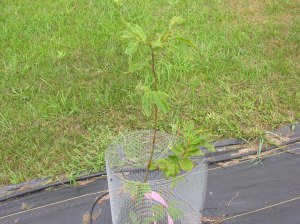
The nuts and seedlings are planted 7 feet apart. Eventually there will be 260 of them in the orchard. The nuts are protected with plastic cones held closed by clothes pins, so the chestnut-crazy wild turkeys don’t get them.

I love a win-win situation, and this is definitely one of them. The Master Gardeners get to participate in an interesting and worthwhile project. The Land Trust preserves green space in a meaningful way. The community has an opportunity to get involved in an eco-friendly project. Best of all, the trees themselves have a chance to someday grow in our forests once again.

Posted in Uncategorized | 11 Comments

Auntie’s Garden

DSCN4987

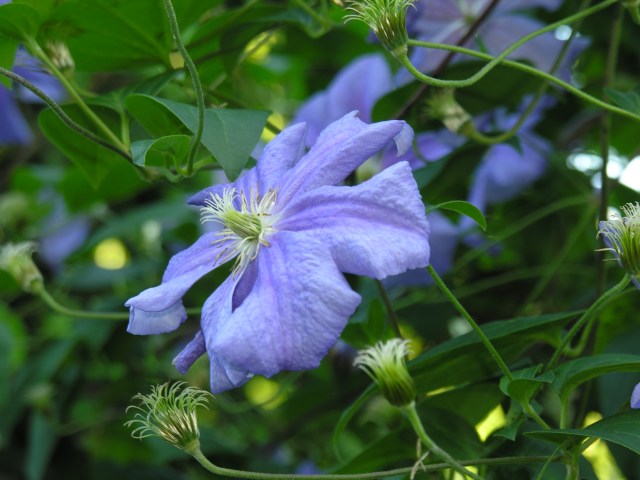
Clematis Perle D'Azur - one of Auntie's favorites

Her name is Edith Ann, but in our family, she is known as “Auntie.” She comes from Connecticut, and has spent her married life just southeast of Montreal – several zones further to the north. Auntie hails from a family that spent summers on a farm and recognized the value of gardening, however, she has never been a vegetable gardener, preferring to work on her large perennial border.

I was not very interested in gardening when I was  young, but I was not entirely uninitiated. Our family spent summers at a  cabin near a lake in the Laurentian mountains, north of Montreal. The growing season was frightfully short, and everything happened so fast in June and July, as if to make up for the  abbreviated season. The plants seemed to sense that they had no time to linger, that it was grow, reproduce and die – all in a couple of months.

It was only when I had my first house that I began to appreciate the depth of Auntie’s knowledge. She had offered me perennial cuttings and was true to her word, arriving with several to get me started. Sensing the potential for finally having someone in the family who could share her passion, she began passing along her gardening magazines and giving me  subscriptions to her favorites. We began discussing the merits of different cultivars – using the botanical names (she insisted!) and I looked forward to visiting that border of hers and taking the long version of the tour. Her garden was at its peak during those years, and was even featured in a popular house and garden magazine.

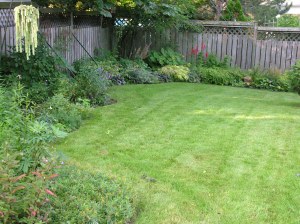
Auntie's garden in August

Auntie's garden, August, 2009

When I moved to Rhode Island, she could no longer give me cuttings and divisions, so she sent me seeds. Each variety was wrapped in its own little handmade envelope of waxed paper, with the description and instructions neatly written on the front. Many of those plants continue to grow in my garden today.

Auntie has not been able to work much in her garden in the past few years. I drove up to Canada a couple of times help her get it cleaned up in the spring, but as the summer progressed, it depressed her terribly to see all the deadheading and weeding that needed to be done, and know she was not strong enough to tackle it. She finally found a woman to set the garden to rights, a horticulturalist who works while Auntie directs her from a lawn chair.

Earlier this year, Auntie had a stroke and we nearly lost her. She is still working on her rehabilitation, and she can no longer get around without a cane, but her interest is as keen as ever.

Lobelia cardinalis

Lobelia cardinalis

It has been said that gardeners are the ultimate optimists, because we are always planning and looking ahead to the future. Auntie’s garden is a reflection of her optimism and her creativity, and as such, it has changed with her over the 50-odd years she has been working in it. It will not live on when she is no longer with us, and she is not the slightest bit sentimental about it either – at least not that I can see. What will live on, though, is the passion for plants that she passed on to me.

I will always have this wonderful thing in my life, and it all began with Auntie’s garden.

Posted in Uncategorized | 5 Comments

The Yummiest Catch

The first year I grew potatoes, there were Colorado Potato Beetle larvae on the leaves just about as soon as they came up, even though no one had ever grown potatoes there before.  I picked them off and had a great harvest. After a few years of not growing them, I succumbed to domestic pressure and planted them again. My husband says that freshly-dug potatoes are several cuts above their sad supermarket counterparts, and he’s right. This time I’m growing All Blue, Yellow Finn, Red Ruby and a fingerling, Princess La Ratte. So far, my garden has been unaffected by  late blight.

"All Blue" and "Princess La Ratte"

"All Blue" and "Princess La Ratte"

I harvested the first potatoes this week, some fingerlings and some blues.  I always find digging potatoes kind of like that TV show, “The Deadliest Catch,” where the crab fishermen never know how they did until they haul up the trap. With potatoes, you dig around – gently, so as not to damage any – and probe your way through the bed. Sometimes you come up with a jackpot and other times, just a fork full of soil. Anyway it’s  kind of exciting, and way more fun than picking beans.

Posted in Uncategorized | 5 Comments

Vegetables for Winter

So you were worried about your vegetable garden failing with all the cool, wet weather in July…and now you are wondering what to do with your excess crops.

Zucchini in the Freezer

Two large zucchinis and I can look forward to seven pots of soup!

Well, if you didn’t donate to your local food pantry you may be thinking of preserving vegetables for winter eating and you may be surprised to learn that all but the “stringy” vegetables can be preserved by freezing. I was amazed because I am new to vegetable gardening and thought you could only preserve if you canned…a process that is daunting to me.

Freezing is an excellent way to preserve vegetables and I found a great website with instructions for freezing everything from artichoke hearts to turnips. Just check out edis.ifas.ufl.edu/FY719 and go to it. The mantra is:  clean, blanch, cool, and freeze. Winter just got a little better!

Posted in Uncategorized | Leave a comment