There’s a Rose on My Street…

Any self-respecting, rose growing gardener knows that the least you can do for your roses is more than you would do for any other plant in your garden…and still, that usually isn’t enough. Roses require constant vigilance in order to nip all problems in the bud (pardon the pun).  
20090717_0197

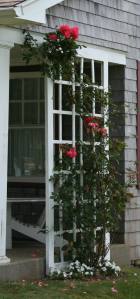
My roses are planted in full sun, protected from wind. I feed them like clockwork, on schedule, from April until September. They get sprayed to keep black spot at bay. When winter approaches they are bedded down with manure, lime, and mulch to keep them healthy and protected until spring. What more can I do? Of course, if I leave home for a week or so in the summer I may return to a most unpleasant sight as fungus and insects and weather take over in my absence.


So, you can understand why I am puzzled because there’s a rose on my street that I  watch all summer…on the north (sunless) side of my neighbor’s house … climbing … thriving … reblooming … with most of its leaves intact and no black spot! And, there is rarely anybody at the house! What is it with these plants. Do they really not appreciate a good life. I have to wonder if a bit more neglect is actually the secret to a happy rose.
Posted in Uncategorized | 3 Comments

They Came, They Saw, They Asked Lots of Questions!

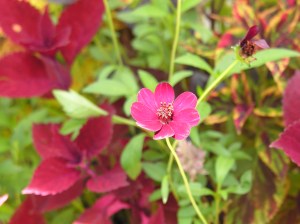
Chocolate cosmos. Yum!

Chocolate cosmos. Yum!

Now that our big “Gardening With the Masters” tour is over, I thought I’d share some thoughts and images with you.

I was a docent at one of the featured gardens, which meant that I showed visitors around and tried as best I could to answer all their questions. Boy, did we ever luck out with the weather! It’s been a horribly rainy summer so far, and it was gloomy and threatening on Saturday morning. But then, as if on cue, the skies cleared, and the rest of the weekend was beautiful.

Perfect weather

Perfect weather!

We welcomed hundreds of people to the garden each day. It was very gratifying to see so many people interested in gardening and getting inspiration from their fellow gardeners.

The living wreath

The living wreath

The beautiful wreath pictured below was designed by the tour host. It is made of sphagnum moss on a wire frame, and planted with sedum, purple allysum and hens and chicks. We had a lot of oohs and ahs over this one.

She also designed the  cool vignette pictured below, right.

I love this!

I love this!

Another popular feature of this garden is the fish pond and waterfall. The water is clear, the fish are happy and the whole lovely thing looks like it was always there.

The waterfall

The waterfall

It’s probably a good thing we do this only every two years. I don’t think the exhausted hosts could take an annual tour!

Posted in Uncategorized | 3 Comments

Ugh! Slugs!

I have been very busy this weekend (sunny at last!) with the garden tour. Here is an interesting and useful post by our friend and Master Gardener colleague, HerbDoc:

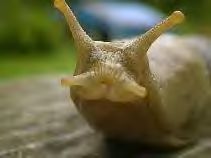
A face only a gastropod could love

A face only a gastropod could love

The cold and wet May and June weather has spawned an unwelcome and destructive visitor in the garden.  Slugs have been feeding on many of the ornamentals, leaving holes and rasped areas on what were perfect specimens.

Slugs are classified as gastropods, more closely related to clams and mussels than insects, so most of the pest control methods on the market simply don’t work.  They aren’t often seen in the day because they’re susceptible to drying out so they seek shelter under pots, boards, large chunk mulch, grass, straw, etc.  In my yard, I found a bunch camping out under three bags of mulch!  They sneak out after dark to feast on vegetables and ornamentals.

There are molluscicides which are pesticides that cause intense irritation and death to slugs and snails on contact.  Metaldehyde (sold as Bug-Geta) is effective for ornamentals but cannot be used near vegetable crops and is deadly for dogs or children if ingested.  Iron phosphate (sold as Sluggo, Escar-Go!  etc.) is as effective as metaldehyde but can be used in vegetable gardens and doesn’t pose any hazards to dogs and children.

My favorite way to get rid of slugs is to bury shallow tuna cans up to their rims and fill them with beer.  Slugs are attracted to fermenting materials so they climb in, get drunk and drown.  They die happy, and I’m delighted to be rid of them!  A container will last several days as long as some liquid is present.  Just keep discarding the dead bodies and adding new beer until there is no further evidence of them.  I also check under my large pots everyday and destroy any slugs lurking beneath.

Keep an eye out for these creatures in your garden!  They lay eggs in soil crevices, and since they can eat forty times their weight in a night, can do a lot of damage in a very short time.

Posted in Uncategorized | 3 Comments

Danger in the Garden: Dog Owners Beware!

Another unpleasant effect of our rainy summer has been a proliferation of mushrooms._Death_cap_mushroom I am betting that if you look carefully in your backyard, you’ll probably  find some. The scary thing is that our dogs can find them before we do, and sometimes they eat them – with fatal consequences. I hadn’t even thought about this until I read a sad story about a dog  in Colorado who died after eating mushrooms.
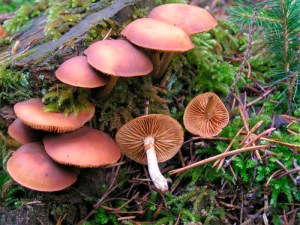
“But that’s way out west”, I said to myself, until I read another sad story that happened much closer to home. So I did a little research and found that there are several poisonous mushrooms growing right here in the northeast. In the case of the poisoned Great Pyrenees, the culprit was a species of Galerina containing deadly amatoxins. (picture below)

galerina marginata

galerina marginata

I learned some important lessons  from this research. For instance, in the case of the Pyrenees, the owner had not actually seen the dog eating the mushrooms, so no one suspected “mushroom toxicosis” and the veterinarian had to do some real detective work – all too late to save the dog.

If your dog is ill, get her to the vet asap, and don’t rule out mushrooms as a possible cause. If you catch your dog eating mushrooms, go the vet immediately, and bring a few pieces of the mushroom with you so everyone knows what they’re dealing with.

Look carefully at the areas where your dog hangs out or plays, and completely dig up and destroy any mushrooms you see growing there. Do not simply kick or smash them, since this can just spread the pieces around. Remember that new mushrooms can spring up overnight, so check often.

Oh, and one more thing: dogs can also have adverse reactions to non-poisonous mushrooms, so it’s better not to let our little darlings go anywhere near them.

If you’re interested in learning more, check out the excellent Cornell University Mushroom Blog.

Posted in Uncategorized | Tagged , | Leave a comment

Hosting a Garden Tour…Big Job, Bigger Rewards!

There are few things as daunting…or as humbling…as allowing your garden to be on a garden tour. For the second time in as many years I signed my garden up to be part of the  Gardening with the Masters Tour. This year it will take place on July 18-19…rain or shine. So now that it is very close to show time all I can do is hold my breath, pray for sun, and ruminate on what I learned from doing this. 

Peaceful shade.

Peaceful shade.

Well, the most important thing is to have a sustainable garden which means that unless winter and spring weather is a disaster (it was close this year), and the local critters band together to launch an assault on your property, and insects and fungi rain down without mercy you won’t have to replace all of your plants.

Take time...smell the roses.

Take time...smell the roses.

Yes, all gardeners fall in love with some plant or plants that really don’t belong in a Rhode Island garden and for these it is all worth the struggle. (Well, maybe not if you ever saw what it takes to keep the hybrid tea roses looking presentable.) But then I realized how planting for sustainability allows me to work with, not against, nature and the environment so the work load is lighter, the stress level is reduced, and my expenses are down.


Pit stop for the birds.

Pit stop for the birds.

I also learned that being on a garden tour is about having an opportunity to talk with your garden visitors and provide a valuable learning experience. Sure, it was a lot of work to prepare the garden…but when the folks arrive and you see the smiles on their faces and get a chance to hear their thoughts and answer their questions the sun shines on all Master Gardeners…rain or shine.

Posted in Uncategorized | Tagged , | 2 Comments

Are My Tomatoes at Risk?

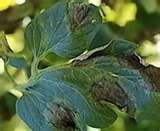
Late Blight symptoms on tomato leaves - water-soaked lesions.

Late Blight symptoms on tomato leaves - water-soaked lesions.

Can you relate to the kind of sinking feeling in your stomach that happens when you think of a summer without tomatoes! That is what happened to me when I found out the Irish potato famine fungus is “out there”…in Rhode Island [and the rest of the Northeast]. Yikes! Late blight! My tomatoes are at risk! First I panicked, and then I decided to get some useful, factual information about this.


OK, so the reason for raising the caution flags is that while late blight occurs sporadically in the Northeast in any given year it is different in 2009 compared to most seasons. One reason is that it is the earliest this disease has been reported over such a broad region of the country. Then, more tragic for the Northeast, is that infected plants have been distributed to large local retail stores from Maine to Ohio. Never before has such an extensive distribution to local retail stores occurred. The problem is this fungus is exceptionally contagious.


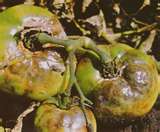
Symptoms of Late Blight on tomato fruit.

Symptoms of Late Blight on tomato fruit.

Here’s what we need to know. The symptoms that develop on tomato leaves, stems, and fruit are quite dramatic and they are obvious to the naked eye. (That’s a relief.) The leaf lesions appear water soaked when the foliage is wet and their edges will be covered with white fungal growth. When the lesions dry out they may appear lime-green or beige in color. This is a good start for identification, but when you see brown to black lesions on the stems…and on the fruit…you KNOW your plants are infected. Here’s the good news: you can still eat the fruit after you remove affected areas because the fungus is not harmful to humans. However, if you have infected plants you must remove the plants from your garden immediately and put in plastic bags for disposal. DO NOT COMPOST.


Tomato stems infected with Late Blight fungus.

Tomato stems infected with Late Blight fungus.

Here are your choices: Spray your tomatoes with a fungicide (must contain the chemical chlorothalonil, as, for example, Daconil) that is a protectant and could keep your plants from being infected. The bad news: the chemical is a carcinogen. The alternative is to do nothing, check your plants daily, and be prepared to give them up if you see any symptoms. The most important thing is that you act quickly to avoid spreading the fungus beyond your garden to neighbors or a nearby commercial grower.


My advice: Enjoy those BLTs…and don’t panic!

Posted in Uncategorized | Tagged | 7 Comments

Gardening with the Masters!

So for the past several weeks, I have been helping two Master Gardeners prepare for the “Gardening with the Masters” tour. Every two years, Rhode Island Master Gardeners open their gardens to the public for an entire weekend. This year, the tour takes place on July 18th and 19th, rain or shine. I thought you might enjoy a sneak preview of one of the more interesting properties.

The "hidden garden"

The "hidden garden"

The tour represents a tremendous amount of work – by the garden creators and by the volunteers who are helping them prepare. There will be 39 gardens on display this year, 33 of which are at private residences.

I am fortunate to be working in one of the loveliest gardens of them all, designed by a couple who focus on native plants, sustainability, and the conservation of resources. There are also some magnificent container gardens to ogleDSCN4733 here (in 2007, they were featured in Better Homes and Gardens) and three sheds – one for potting, one for tools, and a  third shed that serves as a charming studio retreat.
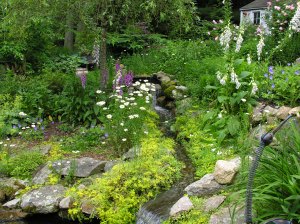
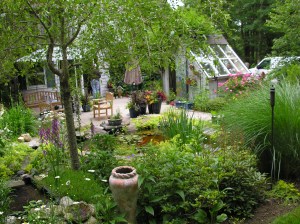
This garden is in a more urban area, but once you start wandering the wooded paths, you feel as though you stepped into a country oasis. The focal point  is a very natural looking waterfall DSCN4715which flows into a pond filled with fat, happy fish.
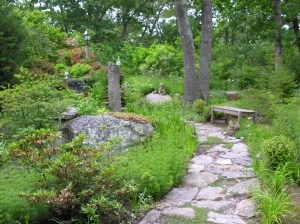
Everywhere  you turn, there’s an interesting spot that encourages you to pause and examine a planting, or just sit, listen to the birds and the flowing water, and enjoy the peaceful, woodland vibe.

For more details of the tour and information on where to buy tickets, click on the “Gardening with the Masters” link on the right of this page.DSCN4734

Posted in Uncategorized | 2 Comments

A Site Where Groundhogs Rule

Groundhogs, woodchucks, whatever you call them, can be the bane of farmers and vegetable gardeners. My own garden is a shambles this year because of the immense groundhog described in my last post. I am not the type of gardener who would trap and harm or kill any of the birds or animals that wander onto my property. I’m more or a “grin and bear it” person.

But some people go even farther and welcome these animals. They feed them, give them cute names, and in the case of one woman, create an entire website about them.  There’s also a blog where people from all over the country send in photos and  stories about “their” groundhogs. As you can imagine, Ground Hog Day is a big deal for these folks.

The name of the website is Hog Haven. Check it out if you want a laugh or two, and Happy 4th, everyone!groundhog-banner4

Posted in Uncategorized | 2 Comments

Life and Death in the Garden

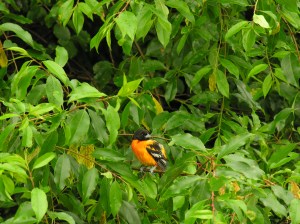
I have lots of orioles this year – Baltimore and Orchard. I noticed this poor fellow yesterday, doing what sick or injured birds do – hunkering down and puffing up. His feathers looked a little worse for wear, too. Not a good sign.

not feeling so hot

not feeling so hot

Then he turned his head, and I saw what looked like an injury. Had he been attacked by another bird? He was still sitting in that tree the last time I looked – a small spot of orange in the dusk. I felt sort of weird closing the door and going back to my book while just outside another being was suffering.  Another life may have ended last night. I don’t know what happened to him but there was no sign of him this morning. I guess it is always possible  he recovered and flew away.

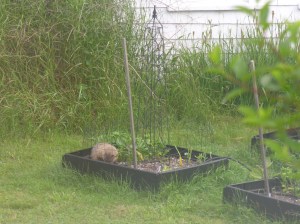
Meanwhile, another drama is playing out in my vegetable garden – at least it’s dramatic to me. For the first time EVER, I have my very own groundhog. And what a groundhog it is! From my kitchen window, it looks to be about the size of my dachshund, and she’s a standard, not a mini. I have three raised beds, all fenced, but notice the effect the fencing is having – NOT.

nothing better than fresh lettuce in the rain!

nothing better than fresh lettuce in the rain!

Lettuce – gone. Beans – gone. Tomatoes – nibbled. The only things it does not eat are spinach, eggplant and beets.

Normally, I would put up a bigger, sturdier fence, but since we’re moving soon, I really don’t see the point. Maybe what we need around here is a Great Horned Owl.

Posted in Uncategorized | 1 Comment

Why all the Fuss?

I have been reading a lot lately about “pet-friendly” gardens, and I will admit  that there are some obvious precautions and design criteria to take into account if your cat or dog (or whatever) is going to be enjoying the yard. Let’s get those out of the way before the sarcasm begins.

beautiful flower, poisonous seeds!

beautiful flower, poisonous seeds!

Here are the real no-brainers:

  • don’t spray toxic chemicals where your pet will be roaming
  • use inorganic mulches so your pet won’t be tempted to chew on bark, or, heaven forbid, cocoa bean hulls, which are toxic to dogs and cats
  • design a garden that is less formal, so it won’t look horrible if someone decides to do some “recreational digging”
  • make sure your pool or water feature is designed so that an animal that falls in has a way to climb out

Rather than obsess over massing plantings to discourage animals from entering the beds, and creating  doggie and kitty pathways, special digging/playing areas and places for them to “do their business,”  I think that creating  harmonious relationships between pets and gardens depends on three basic things:

  1. In the case of dogs, the dog’s breed and behavioral traits. Digger? Chewer? High-energy player? Design accordingly.
  2. Is your dog relaxed and well-behaved, or out of control? You might need a fence or two.
  3. What kind of garden do you want? You might have to give up your dream of Versailles.

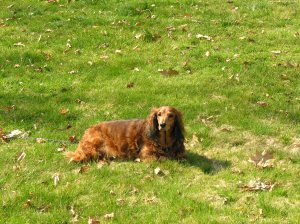
My dog is calm (lucky me!) and well-trained (I trained her) and when she goes out in the garden, she just sits or lies there, sniffing the air, eating the occasional blade of grass, and surveying her domain.

surveying her domain

surveying her domain

I realize that you might still want to learn more about pet-friendly gardening, and naturally, there is a book on that very subject. You can find it here.

Just remember, if you don’t want cats in your flower bed, don’t plant nepeta.

Posted in Uncategorized | 1 Comment